
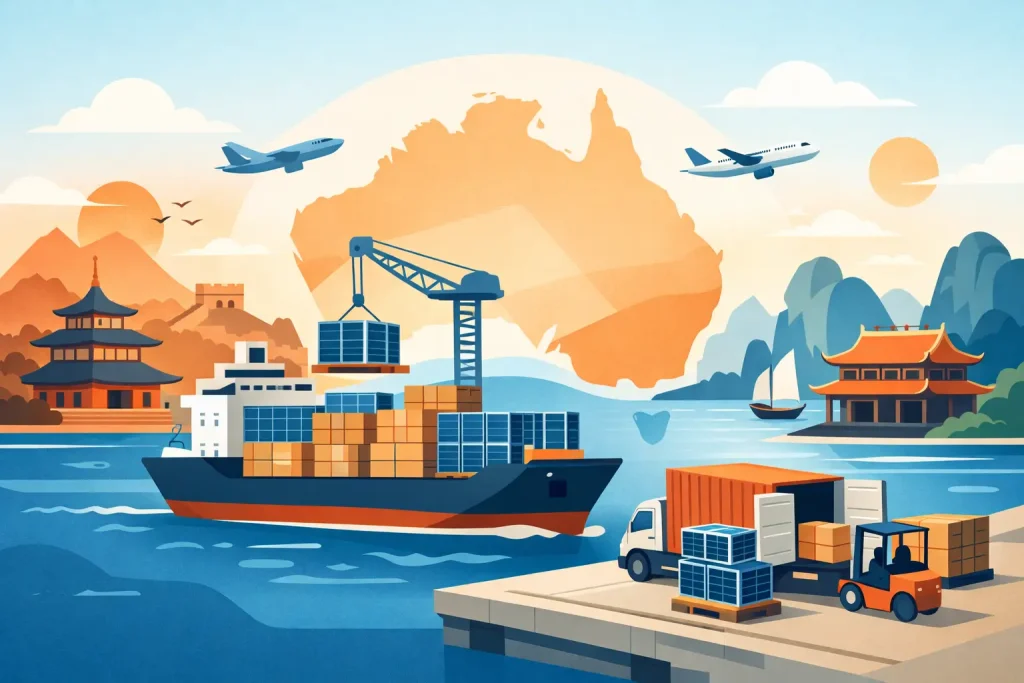
Australia’s demand for solar energy continues to create opportunities for solar retailers, installers, wholesalers, developers and commercial energy businesses. For many Australian companies, China and Vietnam are important sourcing markets for solar panels, solar components and related renewable-energy equipment.
However, importing solar panels to Australia involves much more than finding a supplier and booking a shipping container. Importers need to consider international freight, Australian customs requirements, product compliance, biosecurity, cargo protection and the total landed cost of their shipment.
At MCC World International, we help Australian businesses manage international freight and logistics from major manufacturing centres in China and Vietnam to Australia.
This guide explains some of the key considerations when importing solar panels into Australia.
Why Import Solar Panels from China?
China is one of the world’s major manufacturing centres for photovoltaic equipment and has an extensive supply chain covering:
Solar PV modules Solar cells Mounting systems Solar inverters Battery and energy-storage equipment Electrical components Commercial and utility-scale solar equipment
For Australian importers, the scale of China’s manufacturing sector can provide access to a broad range of suppliers, product specifications and shipment volumes.
Major Chinese ports commonly used for Australian-bound cargo include Shanghai, Ningbo, Shenzhen, Qingdao and Xiamen, depending on the location of the manufacturer and the most suitable shipping route.
Importing Solar Panels from Vietnam to Australia
Vietnam has also developed a substantial manufacturing and export sector, making it another sourcing market worth considering for Australian solar and renewable-energy businesses.
Depending on the supplier’s location, shipments may move through ports such as Ho Chi Minh City/Cat Lai, Hai Phong and other Vietnamese container terminals.
For businesses diversifying their supply chains, sourcing from Vietnam may complement existing procurement from China.
The right solution depends on the supplier, product, shipment size, production schedule and destination in Australia.
Sea Freight for Solar Panels to Australia
For commercial quantities, sea freight is generally the most practical method of transporting solar panels from China or Vietnam to Australia.
Solar panels are relatively large and require careful handling, making containerised sea freight particularly suitable.
Importers generally have two main options:
FCL – Full Container Load
A Full Container Load can be appropriate when the importer has enough cargo to justify using an entire container.
Potential advantages include:
Container dedicated to one shipment Reduced handling compared with consolidated freight Suitable for larger commercial orders More efficient movement of high-volume cargo
Depending on cargo dimensions, weight and packing configuration, different container types may be considered.
LCL – Less than Container Load
For smaller orders, LCL sea freight allows the importer to share container space with other shipments.
This can be useful for businesses testing a new supplier, importing samples or bringing in quantities that do not require a full container.
However, solar panels are fragile, so appropriate packaging and handling are especially important when using consolidated freight.
How Long Does Shipping from China to Australia Take?
Transit time depends on the origin port, destination port, shipping line, route, transshipment arrangements and current vessel schedules.
For example, cargo may be shipped from major Chinese ports to Australian ports including:
Melbourne Sydney Brisbane Fremantle Adelaide
Importers should also allow time for origin handling, export procedures, Australian customs and biosecurity processing, container availability and final delivery.
For time-sensitive projects, MCC can review the available routing options before cargo is booked.
Shipping Solar Panels from Vietnam to Australia
Sea freight from Vietnam is also available to Australia’s major ports.
The total shipping time will vary according to the port of origin, Australian destination, shipping line and whether the service is direct or involves transshipment.
Planning the shipment before the supplier completes production can help avoid unnecessary storage, port and scheduling costs.
Air Freight for Solar Panels and Solar Components
Although sea freight is generally more economical for full commercial shipments, air freight can be useful for urgent solar components, replacement equipment, samples or smaller high-value shipments.
Air freight may be considered when:
Replacement parts are urgently required A project deadline is approaching Samples are required before a larger order Production delays have affected the delivery schedule A small shipment does not justify sea freight
MCC can compare air and sea freight options based on the cargo dimensions, weight, urgency and destination.
Australian Customs Clearance for Solar Panel Imports
Every commercial shipment entering Australia must meet applicable customs and import requirements.
The process can include:
Correct tariff classification Import documentation Customs valuation Assessment of applicable duties and taxes Country-of-origin documentation where relevant Biosecurity requirements Import declarations Supporting commercial documents
Requirements can vary depending on the exact product being imported. Solar modules, inverters, batteries, mounting equipment and electrical components should not automatically be treated as identical products for customs purposes.
Accurate documentation from the supplier is therefore important.
Solar Panel Compliance in Australia
Customs clearance and product compliance are separate considerations.
Before ordering solar panels or associated electrical equipment from an overseas supplier, Australian importers should confirm that the products meet all applicable Australian regulatory, electrical safety and technical requirements.
Depending on the product and intended application, this may involve requirements administered by Australian regulators, standards bodies, state or territory authorities, and relevant solar-industry programs.
Importers should verify compliance before placing a large overseas order, rather than assuming that a product being sold internationally is automatically approved for use or installation in Australia.
Biosecurity and Packaging Requirements
Australia has strict biosecurity controls.
Solar panels themselves may not be the only consideration. The shipment’s timber pallets, crates, packaging and container cleanliness can also affect biosecurity processing.
Importers should ensure overseas suppliers use suitable compliant packaging and provide accurate packing information.
Poorly prepared timber packaging or contamination can lead to inspections, treatment, delays and additional costs after the cargo arrives in Australia.
Protecting Solar Panels During International Shipping
Solar panels require careful handling because impact, pressure or poor container loading can cause physical or concealed damage.
Before shipping, importers should consider:
Manufacturer-approved packaging Strong palletisation Corner and edge protection Appropriate internal restraints Moisture protection Correct container loading Cargo insurance
The cheapest freight quotation is not always the lowest-cost solution if inadequate handling results in damaged products or project delays.
What Documents Are Required to Import Solar Panels?
The documents required will depend on the shipment, but commonly include:
Commercial invoice Packing list Bill of lading or air waybill Product descriptions and specifications Country-of-origin information Customs documentation Relevant certificates or declarations where required Insurance documentation where applicable
Accurate product descriptions are particularly important. Generic descriptions such as “solar goods” may not provide enough information for customs classification and clearance.
Understanding the Landed Cost of Imported Solar Panels
When comparing overseas suppliers, Australian businesses should look beyond the supplier’s unit price.
The landed cost can include:
Product cost + origin charges + international freight + insurance + customs charges + applicable duties/taxes + port/terminal charges + customs/biosecurity costs + local delivery
This gives businesses a much clearer understanding of the real cost of importing their solar products.
MCC can assist importers with understanding the freight and logistics components before a shipment is booked.
Importing Solar Panels from China to Melbourne, Sydney and Brisbane
MCC can arrange freight solutions from major Chinese manufacturing regions to Australian destinations.
Common trade lanes include:
China to Melbourne China to Sydney China to Brisbane China to Fremantle China to Adelaide
We can coordinate the international freight movement and associated logistics from supplier collection through to arrival and delivery requirements in Australia.
Importing Solar Panels from Vietnam to Australia
For businesses sourcing from Vietnam, MCC can also coordinate shipments from Vietnamese suppliers to Australian ports and destinations.
Services can include:
Supplier pickup FCL container freight LCL sea freight Air freight Customs clearance coordination Delivery within Australia Shipment tracking and communication
Having one freight partner coordinate the international movement can simplify communication between the supplier, carrier, Australian importer and other parties involved in the shipment.
Why Use a Freight Forwarder for Solar Panel Imports?
International freight involves multiple parties, documents and deadlines.
An experienced freight forwarder can help coordinate:
Collection from the overseas supplier Export freight arrangements International sea or air freight Shipping documentation Australian customs clearance Biosecurity processing where required Port and terminal arrangements Final delivery to your warehouse or project location
This can be particularly valuable for businesses importing solar products regularly or managing large commercial projects.
Import Solar Panels to Australia with MCC World International
Whether you’re importing solar panels from China to Australia, sourcing solar equipment from Vietnam, or arranging renewable-energy equipment for a commercial project, MCC World International can help manage your international freight requirements.
We provide solutions for:
Sea freight from China to Australia Sea freight from Vietnam to Australia Air freight FCL and LCL shipments Customs clearance Door-to-door freight Commercial and project cargo
Our team can work with your overseas supplier and help coordinate the shipment through to Australia.
Need a Quote for Your Solar Panel Shipment?
If you’re planning to import solar panels, inverters, mounting systems or other solar equipment from China or Vietnam to Australia, contact MCC World International for a freight quotation.
Provide us with your:
Supplier location Port of origin, if known Number of pallets or containers Cargo dimensions and weight Destination in Australia Required delivery date
We can then review the available freight options for your shipment.
Contact MCC World International today to discuss your next solar panel import shipment.