
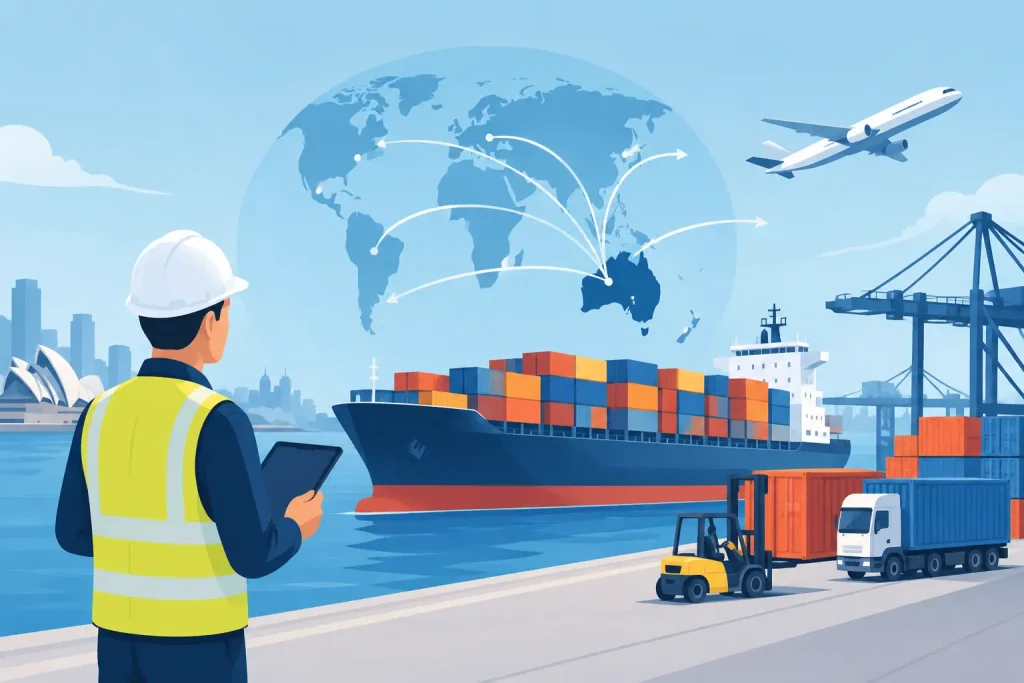
A shipment can be packed, labelled and ready at your warehouse, yet still miss its vessel or flight because a tariff classification is wrong, a document does not match the commercial invoice, or a collection was booked too late. This export shipping process guide sets out the operational decisions Australian exporters need to make before cargo leaves the premises, not after a delay becomes expensive.
Exporting is more than arranging transport from Australia to an overseas port or airport. It is a chain of commercial, regulatory and physical handovers. Each party – exporter, buyer, freight forwarder, carrier, customs broker, depot and overseas agent – needs accurate instructions at the right point in the movement. Good planning protects delivery commitments, cash flow and customer relationships.
Start with the sales terms and shipment scope
The export process begins with the contract of sale. Confirm the Incoterm agreed with the buyer, the named place or port, the currency, payment method and who is responsible for freight, insurance, export clearance and import formalities at destination. A term such as EXW places very different practical responsibilities on the buyer than FCA, FOB, CIF or DAP. It also affects what information your freight provider needs from you.
Be precise about the cargo itself. Record the number of packages, dimensions, gross weight, product description, country of origin, commodity value and dangerous goods status. For machinery, vehicles, oversized pieces or project cargo, include lifting points, loading requirements and site access limitations. A vague description such as parts or equipment can create problems with carrier acceptance, customs declarations and destination clearance.
The transport mode should reflect the commercial priority. Sea freight is usually the efficient choice for larger volumes and less time-sensitive stock. Air freight suits urgent, high-value or lighter consignments, but dimensional weight can materially increase the cost. A combined road, sea and air plan may be appropriate where cargo is collected regionally, consolidated in Melbourne or another capital city, then shipped internationally.
Export shipping process guide: prepare the compliance file
Before a booking is confirmed, establish whether the goods can be exported without permits or special controls. Australian export requirements can apply to goods including defence and strategic items, controlled chemicals, wildlife products, food, timber and some agricultural commodities. Destination-country rules may be stricter still, particularly for labelling, product standards, certification and treatment requirements.
The commercial invoice is the foundation document. It should show the seller and buyer details, a clear goods description, quantities, unit and total values, currency, Incoterm, country of origin and relevant purchase order or reference numbers. The packing list should align exactly with the invoice while adding package-level detail, including marks and numbers, net and gross weights, and dimensions.
Depending on the goods and market, the file may also require a certificate of origin, export permit, phytosanitary certificate, fumigation certificate, insurance certificate, dangerous goods declaration or inspection certificate. Do not treat these as paperwork to be completed after collection. A missing certificate can result in cargo being held, reworked or rejected at destination.
Accurate tariff classification matters on both sides of the transaction. The Harmonised System code helps determine export reporting obligations and the duties, taxes or restrictions the buyer may face overseas. If classification is uncertain, obtain advice before quoting delivered costs or making declarations. A low initial freight rate does not compensate for an avoidable customs issue.
Book capacity and plan the cargo handover
Provide booking instructions early, especially for seasonal demand, regulated cargo and out-of-gauge freight. Your forwarder will need the ready date, cargo details, destination, service level, shipping terms and any special handling requirements. For containerised sea freight, confirm whether the container will be packed at your site, at a packing facility or through a consolidation service.
The booking confirmation should be checked against the commercial requirement. Verify the vessel or flight, port pair, cargo cut-off, documentation cut-off, estimated departure and transit time. Estimated dates are operational guides rather than guarantees. Port congestion, blank sailings, weather, transhipment connections and inspections can alter a schedule, so allow contingency around production and delivery commitments.
Collection timing deserves close attention. A missed container pack, terminal receival window or airline cut-off can move the shipment to the next available service. Ensure the loading area is safe, cargo is accessible and warehouse staff understand the collection time. If using pallets, make sure they are suitable for export, stable, wrapped and labelled on more than one side.
Pack and mark cargo for the full journey
Export packaging must withstand more than the first truck movement. Cargo can be lifted, stacked, moved through terminals, exposed to humidity and transferred between transport modes. Packaging should suit the commodity, route and handling method, not simply look presentable when it leaves the warehouse.
Use appropriate internal protection and moisture control for sensitive goods. Timber packaging must meet international phytosanitary requirements where applicable. For full container loads, distribute weight properly, secure goods to prevent movement and keep a clear record of the seal number. For breakbulk, machinery and other non-standard freight, a professional lashing and securing plan may be required.
Clear external marks support identification through the supply chain. Include consignee details, destination, package number, handling symbols and purchase order references where required. Avoid contradictory labels or descriptions. If the goods are dangerous, packaging, marks, labels and documentation must comply with the applicable air or sea transport code before the carrier accepts them.
Lodge declarations and release cargo for export
Australian exporters may need to provide information for an export declaration, depending on the goods, value and mode of transport. The declaration must match the commercial documents and the actual cargo. Errors in value, quantity, classification, origin or exporter details can cause holds and expose the business to compliance risk.
Your freight forwarder or customs broker can coordinate declarations and carrier documentation, but the exporter remains responsible for the accuracy of the commercial information provided. Keep product descriptions consistent across the invoice, packing list, declaration and bill of lading or air waybill instructions. Small inconsistencies often create disproportionate delays.
Once cargo is delivered to the terminal, depot or airline facility, obtain confirmation of receival. For sea freight, review the draft bill of lading carefully before it is issued. For air freight, confirm the air waybill details. The consignee name, notify party, cargo description, package count and freight terms must reflect the sales arrangement and destination clearance requirements.
Manage the shipment after departure
Departure is a milestone, not the end of the exporter’s responsibility. Track the movement against the planned schedule and advise the buyer promptly if there is a material change. Send documents according to the payment arrangement. Under a letter of credit, even minor documentary discrepancies can delay payment, so document review should be treated as a financial control.
Maintain a single shipment file containing the quotation, booking confirmation, commercial documents, permits, transport documents, export declaration references and delivery evidence. This record supports audits, insurance claims, customer enquiries and repeat shipments. It also makes it easier to identify where cost or time was lost.
After delivery, review the result with your logistics provider. Compare actual transit time, accessorial charges, damage reports and destination feedback against the original plan. Some costs are predictable, such as fuel, terminal and documentation charges. Others depend on storage, inspections, demurrage, detention or a change in buyer instructions. Transparent review helps prevent these costs becoming routine.
Build a repeatable export workflow
The strongest export operations do not rebuild the process for every order. They use approved product data, document templates, packaging standards and clear handover points between sales, warehouse, finance and logistics teams. That does not mean every shipment is identical. A regular palletised shipment to Singapore requires a different control plan from heavy machinery moving to the Middle East or a time-critical airfreight consignment.
Working with an experienced freight partner gives your team one point of coordination across booking, cartage, customs, sea or air freight and destination communication. MCC World International can help align those moving parts with the cargo, route and commercial terms, while keeping compliance and cost visibility in view.
The practical test is simple: before cargo is collected, your business should be able to explain what is being shipped, who carries each responsibility, which documents are required, when the cargo must be delivered and what could delay it. When those answers are clear, exporting becomes a controlled business process rather than a last-minute freight exercise.