
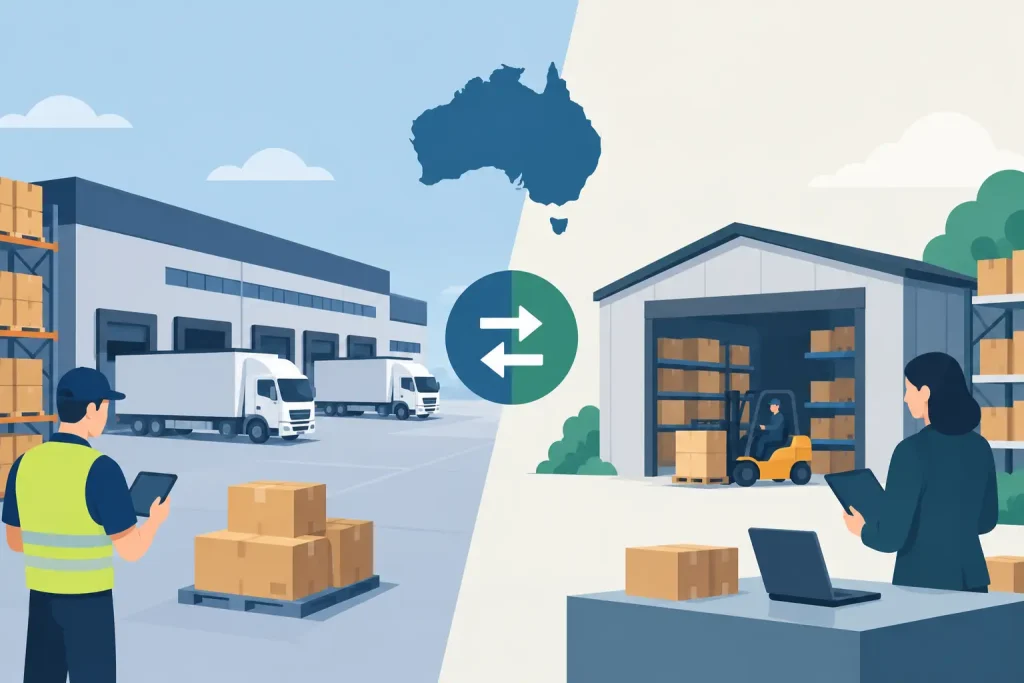
A warehouse decision can change more than your storage costs. It affects delivery promises, stock accuracy, working capital, customer experience and how quickly your business can respond when demand shifts. When weighing 3PL vs in-house warehousing, Australian businesses need to look beyond the quoted pallet rate or lease figure and assess the total operational commitment behind each model.
For an importer, wholesaler, retailer or manufacturer, the right answer depends on stock profile, order volume, service requirements and growth plans. A business moving full containers of stable, high-volume product has different needs from a retailer handling seasonal ranges, mixed-SKU orders and deliveries across multiple states.
What in-house warehousing gives you
In-house warehousing means your business leases or owns the facility, employs and manages the warehouse team, selects systems and equipment, and takes direct responsibility for daily operations. This can provide a high level of control over inventory, processes and customer service.
For businesses with consistent volumes, specialised handling requirements or a highly tailored fulfilment process, that control can be commercially valuable. You can set receiving procedures, pick-and-pack standards, cut-off times and dispatch priorities without relying on another party’s operating model. Your team can also develop deep knowledge of product ranges, including fragile goods, high-value items, regulated stock or complex components.
The challenge is that control comes with fixed cost and management exposure. Rent, rates, utilities, racking, forklifts, warehouse management systems, insurance, labour, training and workplace safety obligations continue regardless of whether outbound orders are strong that month. A warehouse also needs capable supervision, cycle counting discipline and clear processes for receipting, damage reporting, returns and stock investigations.
An in-house operation can make sense where warehouse utilisation remains reliably high and the cost of maintaining capacity is lower than paying a provider’s variable storage and handling charges. It is usually a longer-term commitment, however. Expanding space, recruiting experienced staff or opening a second distribution location takes time and capital.
Where a 3PL model adds value
A third-party logistics provider stores and manages stock on your behalf, generally charging for the space, receipts, picks, packing, dispatches and value-added services used. A well-managed 3PL arrangement turns much of the warehouse cost base from fixed to variable, which can be useful for businesses with changing inventory levels or uncertain growth forecasts.
A 3PL can also provide established infrastructure that would be expensive to build internally: racking, material-handling equipment, trained staff, freight carrier relationships, warehouse systems and documented operating procedures. If your stock arrives through Melbourne but customers are located nationally, the provider’s transport coordination and distribution capability may reduce the number of handovers your team needs to manage.
This is particularly relevant for importers. Container unpacking, palletisation, quarantine or customs-related coordination, warehousing and final-mile delivery are often interdependent. Managing these stages through an experienced logistics operator can improve visibility and reduce delays between port arrival and customer delivery.
A 3PL is not automatically the lower-cost option. Per-unit charges can become significant when volumes are stable and very high, particularly for labour-intensive orders. The value lies in matching the service model to the work required, rather than paying to operate unused warehouse capacity.
3PL vs in-house warehousing: compare total cost, not headline cost
The most common error in this decision is comparing a 3PL storage rate with the rent on a warehouse. Storage is only one part of the cost. A meaningful comparison includes labour, equipment, systems, compliance, insurance, management time, freight administration, stock losses and the cost of errors.
For in-house warehousing, calculate the fully loaded cost per pallet stored and per order dispatched. Include casual labour during peak periods, overtime, forklift maintenance, consumables, packaging, security, stocktake labour and downtime. If a manager is spending several hours each week resolving carrier bookings, investigating shortages or rearranging overflow storage, that is a real operating cost as well.
For a 3PL, ask for a transparent schedule of charges and model it against actual trading patterns. Understand how the provider bills for container unloading, receipting, pallet movements, storage, carton picks, dispatch labels, wrapping, returns, urgent orders and minimum monthly fees. Clarify whether invoices are based on pallets, cubic metres, locations, order lines or units, as each method can materially affect cost.
The strongest business case is usually built from twelve months of realistic activity data, including seasonal peaks. A model that looks economical in an average month may fail during a Christmas rush, a promotional campaign or a delayed shipment that arrives alongside normal stock.
Control is about governance, not just ownership
Businesses sometimes keep warehousing in-house because they do not want to lose control. That concern is valid when the provider relationship is poorly defined. It is less relevant when service levels, reporting and escalation procedures are properly documented.
With an in-house facility, control is immediate, but performance still depends on your management capability. With a 3PL, control should come through agreed service levels: inventory accuracy targets, receipting timeframes, order cut-off times, dispatch performance, damage reporting, cycle-count frequency and response times for discrepancies.
Before outsourcing, establish who owns each decision. Confirm approval procedures for stock adjustments, disposal of damaged goods, short shipments, substitute products, returns and customer collection orders. Require regular reporting that allows your operations team to see stock on hand, stock movement, aged inventory, order status and exceptions without chasing information.
For many businesses, the practical question is not whether they can see the warehouse floor every day. It is whether they can rely on accurate data, clear accountability and prompt action when an exception occurs.
Scalability can matter more than today’s volumes
A warehouse that is right for current stock may be wrong after one large customer win, an expanded product range or a move into interstate distribution. In-house operations can become constrained quickly when racking is full, staging space is limited or labour is already operating at capacity.
A 3PL can usually absorb changes in pallet volumes and order activity more readily, provided the agreement allows for it. This flexibility is useful for seasonal retailers, project cargo businesses, new market entrants and importers whose shipment timing depends on overseas production schedules and shipping line arrivals.
That said, not every 3PL is suited to every product. Flooring, tiles, furniture, textiles, heavy machinery parts and high-value retail goods all have different storage, handling and delivery requirements. The provider must have suitable equipment, site access, security controls and staff training for your cargo profile. For oversized or unusually heavy goods, confirm load limits, handling methods and whether specialised cartage can be coordinated from the warehouse.
Compliance, risk and freight integration
Warehousing is closely connected to broader supply chain compliance. Imported cargo may require careful documentation, quarantine-related handling, customs clearance coordination and controlled release before stock can move into distribution. Dangerous goods, food-related products, medical items and certain chemicals can introduce additional storage and record-keeping obligations.
An in-house facility gives you direct responsibility for meeting these requirements. A 3PL can reduce the administrative burden, but it does not remove your duty to select a capable provider and supply accurate product information. Review licences, insurance arrangements, security practices, workplace safety processes and procedures for damaged or non-conforming stock.
Freight integration is another practical consideration. A warehouse cannot operate efficiently if inbound containers, local cartage, interstate linehaul and final delivery are managed in isolation. MCC World International supports businesses that need these movements planned as one operating chain, particularly where imported goods need to move quickly from arrival through to storage and distribution.
A practical way to make the decision
Start with your operational facts rather than a preference for ownership or outsourcing. Review average and peak pallets held, monthly orders, order lines, SKU count, container arrivals, delivery locations and service expectations. Then identify what makes your stock difficult to handle, whether that is product weight, fragile packaging, serial-number control, batch tracking or urgent dispatch requirements.
If demand is predictable, warehouse utilisation is consistently high and your processes are genuinely specialised, an in-house facility may provide better long-term economics and closer operational control. If volumes fluctuate, capital is better directed towards sales and inventory, or your team is spending too much time coordinating freight and warehouse exceptions, a 3PL may offer a more efficient path.
A hybrid model can also be effective. Some businesses retain a small in-house site for fast-moving stock, showroom supply or specialised work, while using a 3PL for overflow inventory, interstate distribution or seasonal capacity. This approach can protect service levels without committing to excess space year-round.
The useful decision is the one that keeps stock accurate, orders moving and costs visible as your business changes. Build the model around your real freight and fulfilment data, test it against peak demand, and choose the arrangement that gives your operation room to perform rather than simply room to store pallets.