
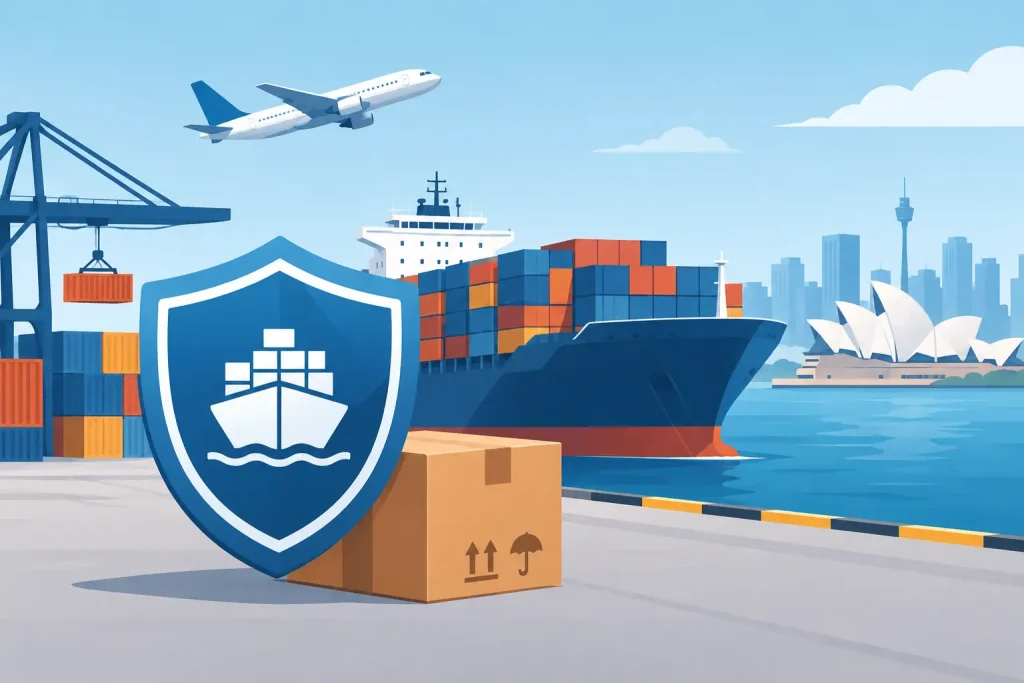
A container can leave its overseas port in sound condition, clear multiple transport handovers and still arrive in Australia with water damage, missing cartons or goods that cannot be sold. Cargo insurance for imports gives businesses a defined financial protection mechanism when that happens, rather than leaving the cost of replacement, disposal and disrupted supply solely with the importer.
For Australian businesses importing stock, machinery, raw materials or specialised project cargo, the question is not whether freight providers take care with cargo. Professional operators do. The issue is that international freight involves risks that sit outside any one party’s control, including severe weather, handling incidents, vessel or aircraft disruption, theft, fire and damage during road transport. A well-structured policy helps protect the value tied up in each shipment.
Why cargo insurance for imports deserves attention
Many importers assume a carrier, shipping line or airline will automatically reimburse the full commercial value of goods if something goes wrong. In practice, carrier liability is usually limited by international conventions, contracts of carriage and the circumstances of the incident. It may be assessed by cargo weight or package limits, not by the invoice value, landed cost or the revenue the goods were expected to generate.
That gap can be significant. A lightweight consignment of electronics, fashion, tiles or components may have a high value per kilogram, while replacement stock may also involve expedited freight, customs costs and additional handling. Carrier liability and cargo insurance are not interchangeable. One relates to the carrier’s legal responsibility; the other is designed to insure the cargo owner’s financial interest, subject to the policy terms.
Insurance also matters because a claim against a carrier can be complex and may require the importer to prove fault. A cargo insurance policy may provide a clearer claims pathway where a covered event has caused physical loss or damage. The exact outcome still depends on the policy wording, evidence and declared value, but the importer is not relying only on a carrier recovery process.
Know when the risk passes to your business
The appropriate insurance arrangement starts with the sales contract and agreed Incoterms. These terms determine which party is responsible for arranging freight and insurance at particular stages of the journey. They do not remove the practical need to understand where your financial exposure begins.
For example, an overseas supplier selling under CIF terms is generally required to arrange marine insurance to a minimum standard. That cover may not reflect the full nature or value of your cargo, and it may have limited scope. Under FOB, FCA, EXW or similar arrangements, the buyer can assume responsibility earlier in the movement. The commercial detail matters more than the label alone.
Importers should confirm who is arranging cover, what insured value is declared, which transport legs are included and whether inland cartage to the final Australian destination is covered. This is especially relevant where cargo moves from a port or airport to a warehouse in Melbourne, Sydney, Brisbane, Perth or another distribution point. A shipment is not necessarily protected for every leg simply because it was insured for international transit.
What import cargo insurance can cover
Most cargo policies are arranged around physical loss of or damage to goods during transit. The broadest common option is often referred to as all-risks cover, although the name can be misleading. It does not mean every loss is covered. It generally covers accidental physical loss or damage unless an exclusion applies.
Depending on the policy and the cargo, cover may respond to events such as:
- Water damage, fire, collision, overturning or accidental handling damage
- Theft, pilferage or non-delivery of packages
- General average and salvage charges following a major maritime incident
- Damage occurring during approved sea, air, road and storage-in-transit movements
More restricted cover may be appropriate for lower-value, less fragile goods or where the business has a higher appetite for risk. However, reducing premium cost by accepting narrow cover can create a material exposure if the cargo is specialised, seasonal, difficult to replace or essential to production.
A standard cargo policy will commonly exclude or limit loss arising from inadequate packing, inherent vice, ordinary wear and tear, gradual deterioration, defective goods, insolvency of a transport provider and war or strikes unless specifically included. Pure financial loss caused by delay is also commonly excluded. If a late shipment causes lost sales, production downtime or contractual penalties but the goods are undamaged, cargo insurance may not respond.
This is why policy selection should be based on the goods, route and commercial consequences rather than the freight rate alone. Refrigerated freight, machinery, vehicles, fragile tiles, furniture, textiles and high-value retail stock each require different questions to be asked before shipment.
Declaring the right insured value
The insured value should be sufficient to put the business back in its financial position after a covered loss, within the policy framework. A common approach is to insure the cost of goods plus freight and insurance, with an agreed uplift that may account for incidental costs and expected margin. The method must align with the insurer’s terms and the commercial documentation available.
Underinsurance is a frequent and avoidable problem. If the declared value is lower than the actual value at risk, the policy may apply an average calculation that reduces the claim payment. Importers should review values whenever supplier prices, currency movements, freight costs or shipment quantities change.
Accurate documentation is equally important. Commercial invoices, packing lists, purchase orders, freight documents and evidence of payment all support the declared value and help establish the nature of the goods. For machinery and project cargo, serial numbers, photographs and condition reports can be particularly useful.
Choosing cover for one shipment or an ongoing import program
Businesses importing occasionally may prefer cover arranged shipment by shipment. This can suit a one-off machinery purchase, a vehicle import or an infrequent consignment where the cargo details vary substantially. It gives the importer visibility of the insurance cost for that movement, but it requires details to be supplied and cover confirmed before risk attaches.
For regular importers, an annual or open cargo policy can be more efficient. It provides an agreed framework for declared shipments over a period, often with streamlined administration and more consistent protection. The business still needs to declare cargo accurately and meet policy conditions, but it avoids treating every shipment as a separate insurance exercise.
The right option depends on shipment frequency, cargo value, supplier terms, transport modes and internal administration. A retailer bringing in monthly container loads has different requirements from a manufacturer importing urgent airfreight parts or a construction business moving oversized equipment for a project.
Protect the claim before a problem becomes harder to prove
If cargo arrives damaged, the first priority is to preserve evidence and minimise further loss. Do not dispose of packaging, repair goods or sign a clean delivery receipt if damage is visible. Note the issue on the delivery documentation, take clear photographs and notify the freight provider and insurer or broker as soon as possible.
Concealed damage should also be reported quickly once identified. Retain the affected goods, cartons, seals and packing materials where practical, as an assessor or surveyor may need to inspect them. Delays in notification or a lack of evidence can make a valid claim harder to progress.
A sound claims file typically includes the commercial invoice, packing list, bill of lading or air waybill, delivery receipt, photographs, survey report where required, repair or replacement quotations and correspondence about the incident. Clear records also support recovery action against responsible third parties where appropriate.
Build insurance into import planning, not damage control
Cargo insurance works best when it is considered alongside freight planning, customs clearance, packing requirements, warehouse delivery and distribution. The policy should match the actual journey, including transhipments, temporary storage and Australian inland transport. Changes to the route, consignee, cargo type or declared value should be checked before the goods move.
MCC World International can help importers coordinate freight movements with the operational information needed to arrange appropriate cover, from shipment details and transport legs through to delivery requirements. This supports clearer decision-making across sea freight, air freight, customs and domestic cartage.
The most useful time to test your insurance position is before the supplier releases the cargo. Confirm the terms, check the value, understand the exclusions and make sure the cover follows the goods to the point where your business takes control. That preparation is far less costly than finding a gap after a shipment has already been damaged.