
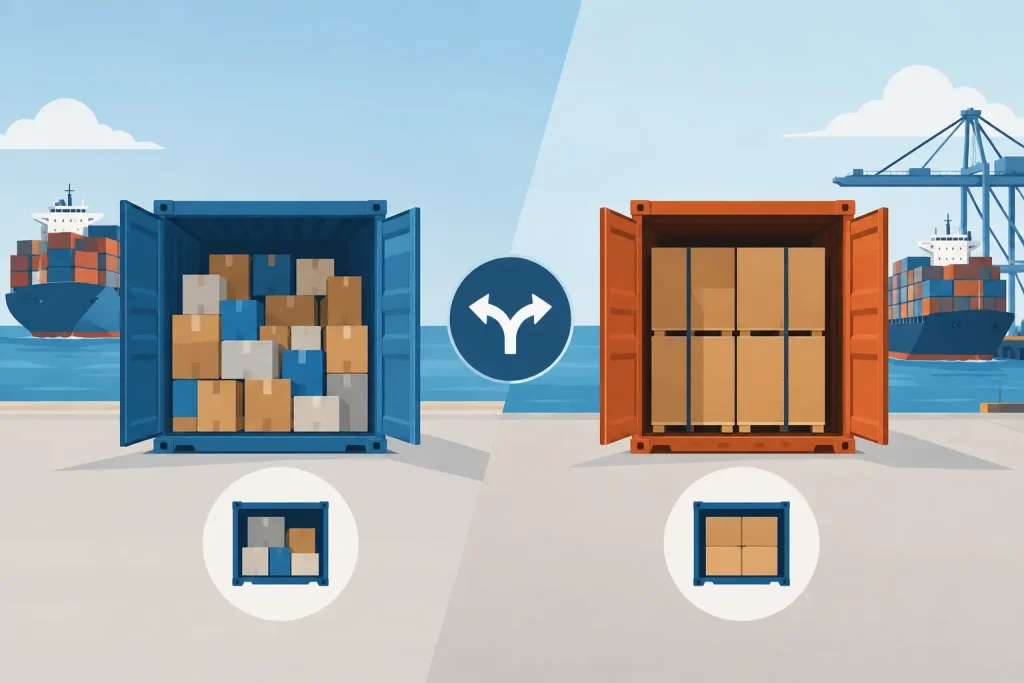
A shipment that occupies only a few pallets can still create a major cost decision. For Australian importers and exporters, LCL versus FCL is not simply a question of container space. The choice affects freight charges, handling exposure, delivery timing, stock availability and the level of control your operations team has over the movement.
The right option depends on cargo volume, dimensions, destination, urgency and how consistently you ship. A lower ocean freight rate does not always produce the lowest landed cost, particularly when consolidation, destination charges and delayed stock are factored into the equation.
LCL versus FCL: the operational difference
LCL means Less than Container Load. Your goods share a shipping container with cargo from other consignees. A freight forwarder or consolidator receives cargo from multiple shippers, packs it into one container and arranges the sea freight movement. At destination, the container is unpacked before each shipment is released for customs clearance and delivery.
FCL means Full Container Load. You book an entire container, commonly a 20-foot, 40-foot or 40-foot high-cube unit, even if it is not filled to capacity. The container is generally packed at your supplier’s premises, a warehouse or another approved loading location, then sealed and moved through the port as one shipment.
This distinction matters because LCL is priced around the space your cargo uses, while FCL is largely priced per container. LCL involves more cargo handling points. FCL generally provides greater control over packing, loading sequence and container security.
When LCL makes commercial sense
LCL can be a practical solution for smaller and less frequent shipments. It allows businesses to move stock without waiting until they have enough volume to justify a full container. This can be particularly useful for new product lines, seasonal buying, replacement stock and test orders where holding excess inventory would tie up working capital.
For example, a Melbourne retailer importing several cubic metres of furniture or homewares may find LCL more appropriate than paying for an underutilised 20-foot container. Likewise, an exporter sending samples, smaller wholesale orders or staged production consignments can use LCL to maintain supply without committing to a full container booking.
However, LCL should be assessed on total cost, not just the quoted sea freight. Charges can apply for origin handling, consolidation, documentation, unpacking, terminal processing, customs clearance, quarantine inspection where required, and local cartage. For dense cargo such as tiles, flooring or machinery parts, chargeable volume and weight can make LCL less economical sooner than expected.
LCL also requires additional time at both ends of the voyage. Cargo must be delivered to a consolidation warehouse before the container can be packed. At the destination port, the container must be unpacked and your goods sorted before collection or delivery can proceed. A shipment may be on the same vessel as an FCL container but still be available later.
When FCL is the stronger option
FCL is often the better choice once cargo reaches a meaningful volume, usually measured in cubic metres, pallets or the number of cartons. There is no universal break-even point because freight rates, port charges, commodity weight and lane conditions change. Still, once an LCL shipment approaches a substantial portion of a container, comparing an FCL rate is essential.
An FCL shipment offers a direct operating advantage: your cargo is loaded into its own container and remains there until it reaches the nominated destination or unpack facility. Fewer handling stages can reduce the risk of damage, loss or mix-ups. This is valuable for high-value retail goods, fragile furniture, textiles, machinery components and goods with strict packing requirements.
FCL can also improve planning for businesses with regular purchase orders. A manufacturer importing production inputs may use a 20-foot container to create predictable replenishment cycles. A wholesaler importing larger retail volumes may use a 40-foot high-cube container to maximise cubic capacity and reduce the freight cost per unit.
The trade-off is utilisation. Paying for a mostly empty container can create avoidable cost, while poor loading can result in cargo movement, damage or wasted capacity. Container packing needs to account for weight distribution, cargo restraint, carton strength, moisture protection and safe unloading at the other end. Heavy goods must be planned carefully to remain within container payload limits and Australian road transport requirements.
Cost comparison: look beyond the freight rate
The most useful comparison is a landed-cost assessment that covers the full movement from supplier to final delivery point. With LCL, the base freight rate may look attractive, but local charges are often calculated separately and can have a larger impact on small consignments. With FCL, the ocean freight may be higher as a single figure, but the cost is spread across the full container load.
A sound comparison should consider origin collection or delivery to port, export documentation, ocean freight, terminal and carrier charges, customs clearance, biosecurity requirements, port-to-door transport, unpacking and storage if applicable. Demurrage and detention risk should also be understood. These charges can arise when containers are not collected, unpacked or returned within the allowed free time.
For businesses importing into Australia, duty and GST are determined by the goods, tariff classification and customs value rather than whether cargo moves LCL or FCL. However, the freight method can influence supporting documentation, delivery timing and the practical coordination of customs and biosecurity clearance. A compliant shipment with complete commercial documents is less likely to face preventable delays.
Transit time and reliability considerations
FCL is normally the more predictable choice for time-sensitive cargo. It avoids waiting for a consolidator to gather enough compatible cargo to fill a container, and it generally has fewer warehouse processes at destination. That does not make FCL immune to vessel delays, port congestion, weather disruptions or industrial action, but it removes several variables associated with consolidation and deconsolidation.
LCL may suit cargo where a few additional days are acceptable. The key is to plan against the cargo availability date, not only the vessel sailing date. A supplier may finish production on time, yet an LCL shipment can miss a consolidation cut-off if it does not arrive at the warehouse before the required deadline.
For retail and project cargo, timing should be measured against the consequence of delay. Missing a store launch, a production run or a site installation window can cost far more than the difference between LCL and FCL freight. In these situations, the lowest shipping price may not be the best commercial outcome.
Cargo type can change the decision
Not every product is well suited to shared-container freight. Fragile, high-value or irregularly shaped goods need careful assessment. LCL cargo is handled more often, and while professional packing and warehouse controls reduce risk, shared-container movements naturally involve more touchpoints.
FCL gives shippers greater control over how cargo is blocked, braced and protected. It may be preferable for furniture, large machinery parts, vehicle components, sensitive goods or consignments with unusual dimensions. It can also help where cargo needs to remain grouped by purchase order, store allocation or project location.
Some goods may require specialised packing, dangerous goods declarations, fumigation evidence, timber treatment certificates or other compliance documents. Australian biosecurity requirements can be particularly relevant for timber packaging, used machinery and cargo exposed to soil, plant material or contamination. Freight mode does not remove these obligations, but early planning avoids expensive intervention at the border.
How to make the right choice for each shipment
Start with accurate cargo information: carton count, dimensions, gross weight, cargo value, ready date, collection address and final delivery location. An estimate based only on a supplier’s broad description can lead to unexpected charges or an unsuitable container plan.
Then compare LCL and FCL on a like-for-like basis. Ask whether the quote includes all expected origin and destination charges, whether delivery is to port or door, and how long cargo will take to become available after vessel arrival. Consider whether the shipment can be combined with another purchase order, or whether delaying it would create an inventory risk.
For regular import programs, reviewing historical shipment volumes can reveal patterns that one-off quotes miss. A business sending several LCL consignments from the same supplier within a short period may be better served by consolidating orders into an FCL movement. Conversely, splitting a full container into staged LCL shipments may protect cash flow when demand is uncertain.
The most effective freight decision is the one that supports stock continuity, compliance and total landed-cost control. MCC World International can assess cargo characteristics, shipping schedules, customs requirements and local delivery needs together, so the selected service reflects the way your business actually operates.
Before confirming your next booking, compare the container option against the cost of delayed stock, extra handling and underused space. That practical calculation will usually make the best path clear.