
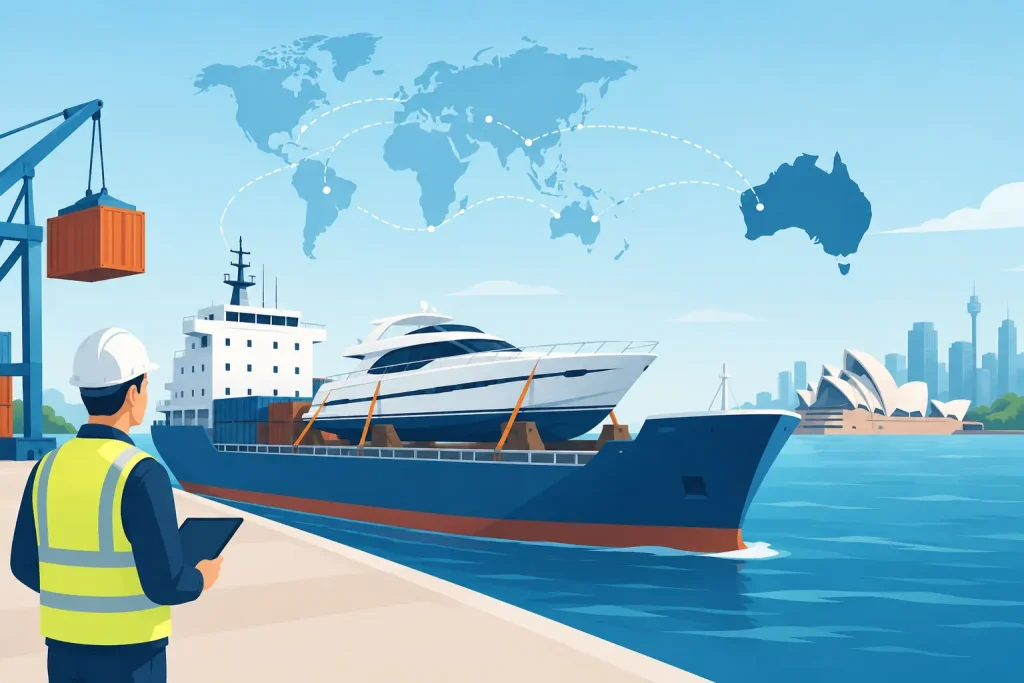
A vessel can be ready at the marina, professionally cleaned and insured, yet still miss its intended sailing because its cradle, export documents or port delivery booking were not confirmed. Boat transport overseas is a specialised freight movement, not simply vehicle shipping on a larger scale. The boat, its dimensions, its condition and its destination-country rules all influence the plan.
For Australian importers, exporters, dealers and project teams, the right approach is to establish the shipping method and compliance requirements early. This protects the cargo, gives stakeholders a clearer cost position and avoids expensive delays at the wharf.
Choosing the right method for boat transport overseas
The best shipping option depends on the boat’s dimensions, value, route, timeframe and whether it can travel exposed to the elements. There is no single method that suits every yacht, trailer boat, commercial vessel or personal watercraft.
Roll-on/roll-off, commonly called RoRo, is often suitable for boats on trailers or purpose-built cradles that can be safely moved onto and off the vessel. It can be a practical option on established trade lanes, particularly where the boat can be delivered to the terminal ready for loading. However, RoRo schedules, receiving rules and cargo acceptance criteria vary by carrier and port.
Container shipping can provide a high level of protection for smaller boats that fit within an appropriate container configuration. Depending on dimensions, this may involve a standard container, high-cube container or specialised arrangement. The boat must be professionally secured, with its trailer or cradle engineered for transport loads. Containerisation may also simplify handling at some destination ports, but packing, lashing and weight distribution require careful planning.
For larger, non-containerisable boats, flat-rack shipping, breakbulk or lift-on/lift-off services may be required. These methods allow for oversized dimensions but involve specialised lifting, cradling and terminal handling. They can be more complex and may carry higher handling costs, particularly where cranes, permits or escorted road movements are required.
A purpose-built yacht carrier may be the preferred solution for certain recreational or high-value vessels. Availability depends on the route and vessel schedule, so it is usually necessary to plan well ahead. The right option should be assessed against total landed cost, handling risk, transit certainty and destination capability rather than headline ocean freight alone.
Start with accurate boat measurements and condition details
A reliable freight plan begins with accurate information. A small difference in height, beam or overall length can move a shipment from a standard solution to an out-of-gauge movement with different equipment and pricing.
Provide the boat’s overall length, beam, height, weight and draft where relevant. Measurements should include antennas, radar arches, flybridges, outriggers, keels, trailers and any removable equipment. Confirm whether the boat is on its own trailer, whether that trailer is roadworthy, and whether it can be moved safely at the origin and destination.
Clear photographs are equally valuable. They help freight planners identify lifting points, hull shape, trailer condition and the protection needed around fragile fittings. A pre-shipment condition report should record existing marks, damage and loose components. This is particularly important where the boat will pass through several handling points before being loaded aboard the vessel.
Preparing a boat for international shipment
Marine preparation is a core risk-control measure. Fuel, batteries, water systems, loose equipment and protruding fittings all need attention before cargo is accepted at port.
Fuel levels are generally reduced in line with carrier requirements, while batteries may need to be isolated or disconnected. Gas bottles, flares, chemicals and other dangerous goods require declaration and may be restricted. Personal belongings should not be left on board unless they have been specifically declared and approved for carriage. Undeclared goods can create customs issues and may not be covered by insurance.
Remove or secure detachable items such as canopies, cushions, electronics, fishing gear, covers and navigation equipment. Antennas, masts and radar arches may need to be lowered or removed to meet shipping dimensions. Drain bilges and water tanks where appropriate, secure hatches and doors, and ensure the boat is clean enough to satisfy biosecurity requirements.
For imports into Australia, cleanliness is especially significant. Mud, plant material, insects, food residue and marine growth can trigger inspection, cleaning or treatment requirements. Exporters should also check destination-country biosecurity rules before the boat is delivered to the port. Cleaning completed before shipment is generally easier to manage than work ordered after arrival.
Customs, documentation and compliance
International boat movements require more than a commercial invoice and a booking reference. Documentation must accurately identify the boat, transaction value, ownership and the parties responsible for import or export declarations.
Typical documents may include the bill of sale, registration papers, commercial invoice, packing details, insurance certificate and export or import declarations. Depending on the shipment, there may also be a requirement for certificates of origin, dangerous goods documentation, treatment certificates or evidence of compliance with local standards.
For boats entering Australia, duty and GST may apply, subject to the classification, value, origin and any applicable trade agreement. The customs value is not always limited to the purchase price. International freight, insurance and other assessable costs can affect the customs calculation. Importers should confirm their likely tax exposure before committing to a purchase or finalising a landed-cost budget.
Australian Border Force and biosecurity requirements must be managed alongside carrier and port rules. A shipment can arrive on time but still be held if paperwork is incomplete or the vessel requires inspection. Early customs review is particularly useful for used boats, vessels with overseas equipment on board, and shipments with unusual ownership structures.
Understanding the real cost of overseas boat shipping
Ocean freight is only one part of the total cost. A useful quote should make the main cost components visible, so procurement and operations teams can compare options on a like-for-like basis.
The final figure may include origin collection or marina delivery, cradling and lashing, export handling, port charges, sea freight, marine insurance, destination handling, customs clearance, biosecurity inspection, duties and taxes, and final delivery. Oversize cargo can also require craneage, special equipment, permits or road escorts.
Freight rates move with vessel capacity, fuel costs, port congestion, route demand and the dimensions of the cargo. A quote with a lower ocean rate may not be the lower-cost solution if it excludes terminal handling, destination charges or essential securing work. Ask what is included, what is estimated and which charges can change after the shipment is received or measured.
Transit time should be treated in the same way. Port-to-port sailing time is not the complete picture. Allow for booking lead time, delivery cut-offs, export processing, transhipment, arrival clearance and local transport to the final site. If the vessel is needed for a launch date, retail handover or project deadline, build contingency into the schedule.
Protecting the boat throughout the journey
Marine cargo insurance should be considered separately from the carrier’s liability. Carrier liability is often limited by international conventions and service terms, and it may not cover the full value of a boat or the commercial impact of damage.
The right insurance cover depends on the cargo value, route, shipping method and policy conditions. Confirm the insured value, exclusions, deductible, packing requirements and claims process before loading. Some policies require professional packing and documented evidence of the boat’s condition at handover.
Protection also comes from control at each transfer point. The boat may move from a marina to a transport depot, then to port, onto a vessel, through a destination terminal and onward by road. Every handover should have clear instructions, contact details and confirmation of responsibility. Coordinated communication becomes especially important where the cargo is oversized or the destination has restricted access.
Coordinate the full movement, not just the sea leg
The ocean crossing is usually the most visible part of an overseas boat shipment, but the difficult work often sits on either side of it. A practical freight plan brings together local cartage, port delivery, customs brokerage, terminal handling and final-mile transport as one controlled movement.
MCC World International can coordinate these connected stages for commercial shippers, with planning tailored to the boat, route and delivery requirements. This is valuable where a shipment needs Australian collection, export customs support, specialised handling or destination-side coordination through established freight partners.
Before approving a booking, confirm who is responsible for the cradle, loading plan, cargo insurance, port delivery appointment, customs entry and delivery from the destination terminal. A clear responsibility matrix prevents gaps between suppliers and gives your team one workable schedule to manage.
A boat shipment is best treated as a planned supply-chain movement rather than a last-minute port booking. When dimensions, documentation, condition checks and delivery responsibilities are resolved before the cargo moves, overseas transport becomes far more predictable.