
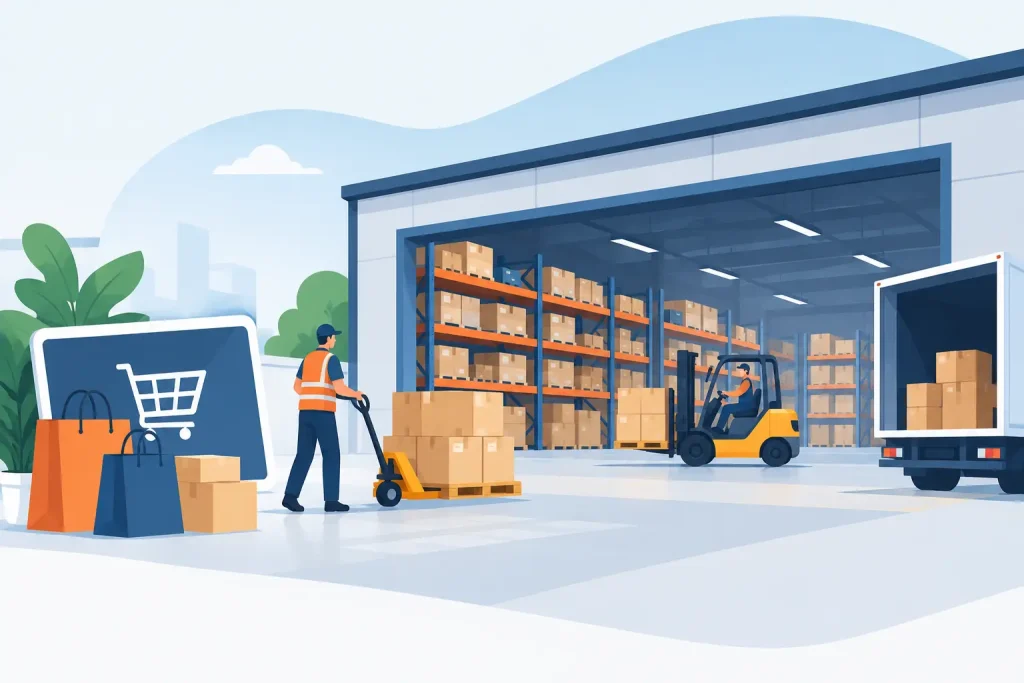
Retail stock problems rarely start on the shop floor. They start when imported containers arrive before space is available, online orders compete with store replenishment, or slow dispatch leaves popular lines unavailable when demand peaks. The best warehousing solutions for retailers create control across these pressure points, turning storage into a reliable part of the supply chain rather than an ongoing operational constraint.
For Australian retailers, the right model depends on more than the number of pallets required this month. It must account for import volumes, product range, sales channels, seasonal swings, delivery requirements and the cost of holding inventory in the wrong location. A warehouse should support the way a retailer sells, replenishes and grows.
What retailers need from a warehouse
A retail warehouse has to do more than receive cartons and hold stock. It needs to protect inventory, provide accurate visibility and move goods quickly into the next stage of distribution. For a business importing furniture, flooring, textiles, tiles or general merchandise, this often begins at the port with container unpacking, stock checks and careful handling before goods are put away.
From there, the operation needs to support several inventory flows at once. Retail stores may need scheduled replenishment by carton, pallet or item. E-commerce customers expect prompt, accurate order fulfilment. Wholesale customers may have specific labelling, booking and delivery requirements. If these workflows are handled manually or through separate providers, errors and unnecessary transport costs can quickly follow.
Retailers should also consider the quality of information provided by a warehousing partner. Inventory reports, receiving records, order status and proof of delivery help purchasing and operations teams make better decisions. Visibility is particularly valuable when stock is travelling from overseas suppliers and lead times are already long.
Best warehousing solutions for retailers by operating model
There is no single warehouse model that suits every retailer. The right choice is driven by volume consistency, product characteristics, capital available and the level of control the business requires.
Multi-client 3PL warehousing
Third-party logistics warehousing is often the most practical option for retailers with changing stock levels or a growing number of orders. A retailer shares the facility, labour and systems with other clients while paying for the storage and services used. This can avoid the fixed cost and management burden of operating a dedicated site.
A capable 3PL provider can receive imported cargo, unpack containers, store inventory, pick and pack orders, arrange store deliveries and coordinate metropolitan or interstate transport. For retailers operating across Australia, combining warehousing with freight coordination can reduce handovers between suppliers and provide clearer accountability when goods are delayed or damaged.
The trade-off is that service quality depends on clear operating procedures and agreed service levels. Retailers should confirm cut-off times, order accuracy targets, stocktake processes, claims procedures and escalation contacts before moving stock into a shared facility.
Dedicated warehousing
A dedicated warehouse, or a defined area within a larger facility, suits retailers with stable high volumes, specialised products or complex handling needs. It offers greater control over processes, labour allocation and site layout. This can be useful where stock requires particular storage conditions, serial-number management, quality inspections or custom fulfilment work.
The cost is higher because the retailer takes on more fixed space and labour commitments. During quieter periods, unused capacity can become expensive. For this reason, dedicated warehousing is generally a stronger fit for established retailers with predictable demand than for businesses managing uncertain growth or highly seasonal product lines.
In-house warehousing
Operating an in-house warehouse can make sense where a retailer has consistent volume, a long-term property strategy and experienced warehouse management. It gives the business direct control over staff, systems, security and service standards.
However, it also creates responsibility for recruitment, safety, equipment, technology, insurance, compliance and transport coordination. A warehouse lease may appear cost-effective on a square-metre basis, but the full operating cost is much broader. For many importers, using external warehousing while retaining control of planning and customer service offers a more balanced approach.
Cross-docking and short-term overflow storage
For fast-moving stock, cross-docking can reduce the time goods sit in storage. Products are received, sorted and dispatched to stores or customers with minimal put-away. This is useful for promotional stock, seasonal ranges, urgent replenishment and container loads allocated to multiple retail locations.
Short-term overflow storage also helps retailers manage the period between arrival and distribution. It can be particularly valuable before Christmas, during major sales campaigns or when a delayed vessel causes several shipments to arrive close together. This model only works well when transport bookings, inventory data and receiving plans are aligned in advance.
Match the warehouse to your inventory profile
The nature of the product should shape the warehousing decision. Bulky furniture needs different handling and racking from small consumer goods. Tiles and flooring need secure storage, appropriate equipment and careful damage prevention. Apparel and textiles may require piece-picking, repacking and seasonal stock rotation. High-value electronics need stronger security and controlled access.
Retailers should map their stock by dimensions, weight, fragility, expiry exposure, sales velocity and order profile. A warehouse designed for full-pallet dispatch may be efficient for wholesale orders but unsuitable for a business processing hundreds of small online orders each day. Likewise, an operation built around e-commerce picking may add unnecessary cost to a retailer sending mostly bulk store replenishment.
Location also has a direct effect on delivery performance and freight spend. A Melbourne-based importer may benefit from warehousing close to the port or major freight routes, particularly when containers are arriving regularly. Yet a national retailer may need stock positioned closer to customers in other capital cities. The best answer may be one central distribution point, a network of facilities, or a staged model that changes as sales demand develops.
Systems, accuracy and retail compliance matter
A warehouse management system should provide more than a stock balance. Retailers need confidence that stock is receipted correctly, allocated to the right sales channel and dispatched under the correct customer or store requirements. Integration with inventory, order management and transport systems can reduce rekeying and give teams a more reliable view of available stock.
Before appointing a provider, ask how receiving discrepancies are recorded, how damaged stock is quarantined and how stock adjustments are authorised. It is also sensible to understand cycle-counting frequency, annual stocktake support and the process for investigating variances. Low storage rates offer little value if inventory accuracy is poor.
Retail compliance can add another layer. Major retailers, marketplaces and wholesale customers may require carton labels, barcodes, ASN processes, delivery appointments or specific pallet configurations. A warehousing partner should be able to work to documented requirements without creating delays at dispatch.
Assess the total cost, not just the pallet rate
Storage pricing is only one part of the warehousing cost. Receiving, container unloading, palletisation, pick fees, packaging, labelling, stocktakes, administration and transport can materially change the final cost per order or per unit. Retailers should request a clear schedule of charges based on their genuine operating profile, including peak-season volumes and exceptions.
It is equally important to assess the cost of poor service. A missed store delivery can result in lost sales. Incorrect online orders create returns and customer service work. A container held up because delivery, unpacking and storage were not coordinated can generate avoidable charges. Transparent pricing and defined account management help businesses identify these risks early.
An integrated provider can simplify this calculation by coordinating sea or air freight, customs clearance, cartage, warehousing and final distribution through one operating plan. MCC World International supports this type of end-to-end approach for retailers that need imported cargo moved through Australian supply chains with greater control.
Build flexibility into the decision
Retail demand does not stay static. New product ranges, changing supplier lead times, promotions and shifts between store and online sales can all alter warehouse requirements quickly. Rather than choosing solely for current capacity, retailers should test whether a provider can add space, labour and transport support when volumes rise.
The most effective arrangement is usually one that gives the retailer clear inventory control without locking the business into unnecessary fixed cost. Start with accurate data on inbound containers, stock turns, order volumes and delivery destinations. Then select a warehousing model that supports the next stage of growth while keeping every handover, from port arrival to final delivery, accountable.