
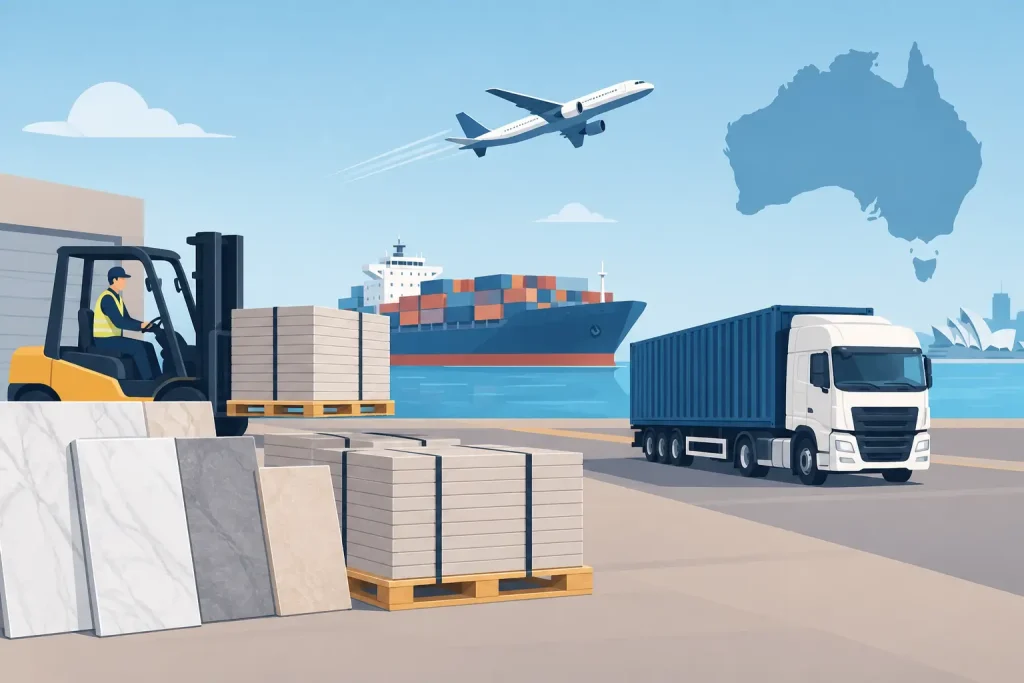
A container of tiles can look straightforward on a purchase order, then become a costly problem once weight, breakage risk, port handling and delivery access are overlooked. When businesses search for the best freight options tiles can travel under, the answer is rarely one transport mode. It is the combination of freight method, packing standard, customs planning and final-mile delivery that protects the product and the margin.
For Australian importers, wholesalers, retailers and project suppliers, tile freight needs to be planned around the shipment’s actual commercial requirements. A low-value replenishment order may suit consolidated sea freight. A shortfall threatening a construction deadline may justify air freight for a limited quantity. Heavy full-container loads require a different delivery plan again.
Choose Freight by the Tile Shipment Profile
Tiles are dense, fragile and often packed in multiple cartons on pallets or in wooden crates. Their cubic volume may appear manageable, but their gross weight can quickly push a shipment into a more expensive freight or delivery category. Porcelain, ceramic, stone, terrazzo and large-format tiles also respond differently to handling pressure and vibration.
Before selecting a service, confirm the total weight and dimensions, number of pallets or crates, collection location, supplier readiness date, Australian destination, required delivery date and whether the goods are required for a staged project. It is also necessary to establish the commercial value, Incoterm and whether the supplier’s packaging is suitable for international movement.
The best option is not always the lowest quoted freight rate. A cheap rate can lose its advantage if the cargo is poorly packed, held for incomplete documents, delivered on a vehicle that cannot access the site, or left at a depot while demurrage and storage charges accumulate.
Best Freight Options for Tiles: Sea Freight
Sea freight is normally the most commercially effective option for tiles moving from overseas suppliers into Australia. It accommodates heavy cargo efficiently and provides the capacity needed for regular stock replenishment, containerised imports and large project orders.
Full Container Load for larger orders
A full container load, or FCL, gives the importer sole use of a container. It is generally the preferred approach when tile volumes are sufficient to fill, or nearly fill, a 20-foot or 40-foot container. A 20-foot container is commonly suitable for dense products because weight limits can be reached before the container is physically full.
FCL reduces handling between origin and destination compared with a consolidated shipment. This can lower the likelihood of carton damage, crushed corners and pallet movement. It also provides stronger control over loading, container condition, securing and delivery timing.
However, an FCL shipment must be planned carefully. Weight needs to be distributed correctly across the container floor, cargo must be restrained, and the receiving site must be able to accept the container or accommodate unpacking and delivery via local cartage. A factory, warehouse or trade depot may be suitable, while a congested building site or retail location may require a different final-mile arrangement.
Less than Container Load for smaller volumes
Less than Container Load, or LCL, is appropriate when the order does not justify a full container. The goods share container space with other importers’ cargo, allowing businesses to buy smaller quantities without paying for unused container capacity.
LCL can be a sensible solution for sample orders, mixed stock lines, trial ranges and lower-volume replenishment. The trade-off is additional handling at consolidation and deconsolidation points. Because tiles are vulnerable to impact, strong pallets, edge protection, shrink wrap and, where appropriate, crating are essential. LCL transit can also be less predictable than FCL because the shipment depends on consolidation schedules and cargo availability from other shippers.
For a high-value tile range or fragile large-format product, it is worth comparing the apparent saving of LCL against the handling reduction and control available through FCL.
When Air Freight Makes Commercial Sense
Air freight is not usually the primary transport method for tiles. The chargeable weight and the product’s density can make it expensive quickly. Yet there are situations where it is the right operational decision.
Air freight can support urgent showroom samples, replacement stock for damaged or missing items, a small quantity needed to complete a project, or a priority product line that cannot wait for the next sea freight sailing. It is most effective when used selectively rather than as a substitute for regular inventory planning.
Air freight planning still requires suitable packaging. Tiles should be secured in reinforced cartons and protected from movement within the pallet or crate. The shipment must also be assessed for airport terminal handling, delivery access and customs clearance timing. Paying for a fast flight provides little benefit if documents are incomplete or delivery cannot be arranged promptly after clearance.
Domestic Road Freight and Final-Mile Delivery
The freight journey does not end at an Australian port or airport. Tile cargo often needs specialist local delivery planning due to its weight and the conditions at the receiving point.
Palletised freight may travel by tail-lift vehicle, forklift unload or side-loader depending on the load and site capability. A residential construction site, CBD retail fit-out or regional project can present restrictions such as narrow access, booking requirements, height limits, no forklift and limited unloading space. These details should be identified before cargo is dispatched from the depot.
For major Australian cities, local cartage can be coordinated around delivery appointments and equipment requirements. For regional destinations, transit time, linehaul schedules and site communication need to be factored into the overall programme. A delivery that arrives on time but cannot be unloaded safely is not a successful delivery.
Protect Tiles Before They Enter the Freight Network
Freight selection cannot compensate for weak packing. Suppliers should load tiles onto sound pallets that suit the carton dimensions, avoid overhang, apply corner boards and use stretch wrap or strapping that keeps cartons stable without causing damage. Heavy pallets need bases capable of forklift handling, and crates should be used where the product format or journey warrants extra protection.
Large-format tiles deserve particular attention. Their size makes them more susceptible to flexing and breakage, while their weight can create manual-handling risks for warehouse and delivery teams. Clear markings for weight, orientation and fragile handling assist, but physical restraint and correct pallet design remain the main protection.
It is also prudent to document the cargo condition before collection. Photos of pallet build, wrapping, labels and container loading can assist with quality control and, if necessary, claims assessment. Cargo insurance should be considered based on the commercial value of the goods and the risk the business is prepared to retain.
Customs, Biosecurity and Cost Control
Australian tile imports may require customs declarations, tariff classification, duty and GST assessment, and compliance with any applicable import conditions. The correct tariff classification depends on the product material and specifications. Errors can lead to delays, incorrect duty treatment or post-entry compliance issues.
Timely documentation is central to a controlled import process. Commercial invoices, packing lists, bills of lading or air waybills, supplier declarations and any relevant product information should be accurate and available before arrival. Where timber packaging is used, it must meet Australian biosecurity requirements. Non-compliant packaging can result in treatment, re-export or disposal costs.
Cost comparison should extend beyond the headline ocean or air rate. Assess origin charges, destination terminal costs, customs clearance, delivery, unpacking, storage exposure, container detention and any accessorial charges. For recurring imports, a landed-cost view gives procurement and operations teams a more reliable basis for comparing suppliers and freight models.
Build a Freight Plan Around Stock and Project Dates
Tile importers gain more control when freight is tied to a practical inventory plan. Regular FCL movements may suit a distributor with consistent sales volumes, while an importer testing new ranges may combine LCL for initial orders with FCL once demand is established. Project cargo should be scheduled against site milestones, with allowance for port congestion, customs processing and local delivery bookings.
MCC World International can coordinate sea, air and domestic freight alongside customs clearance, warehousing and distribution, giving businesses one operational point of control across the movement. This is particularly valuable where containers need unpacking, stock needs to be held before release, or deliveries must be sequenced across multiple sites.
The right choice is the freight option that arrives in usable condition, clears compliantly and reaches the customer or project site when required. Start with the tile’s weight, fragility and deadline, then build the transport plan backwards from the final delivery point.