
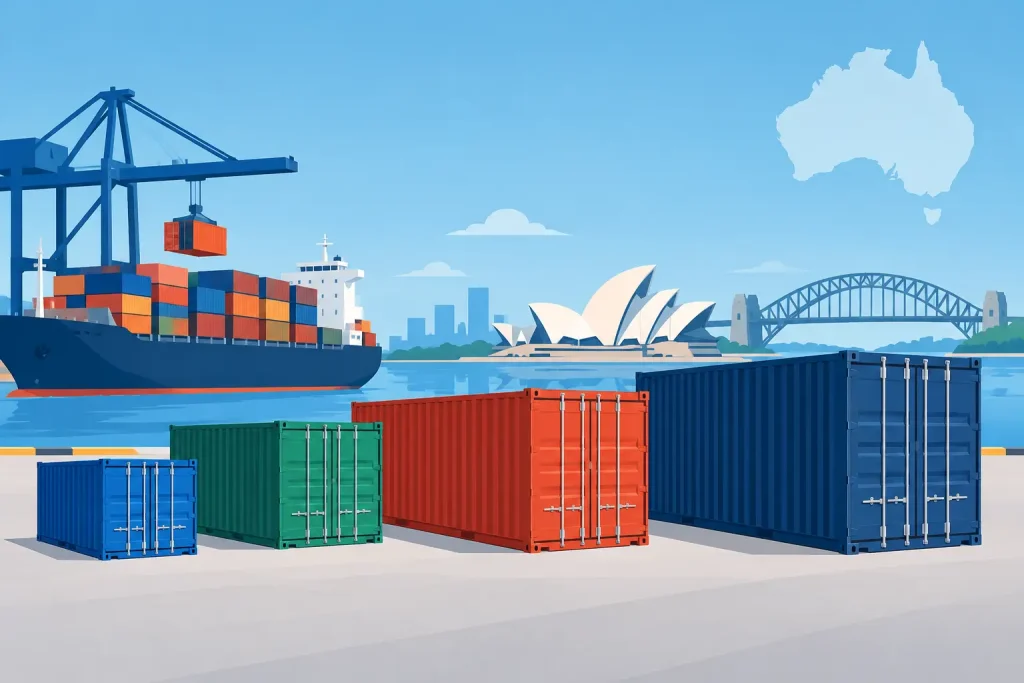
A container that is too small can force an additional shipment. One that is too large can add avoidable freight, handling and delivery cost. For Australian importers and exporters, understanding shipping container sizes is a practical part of controlling landed costs, protecting cargo and selecting the right transport plan from origin through to final delivery.
Container dimensions are broadly standardised under ISO specifications, but usable space, tare weight, door openings and maximum payload can differ slightly by shipping line, manufacturer and container age. The figures below are reliable planning guides, not loading authorities. Always confirm the specific container’s plate details and carrier requirements before cargo is packed or collected.
Standard shipping container sizes
The most commonly used general-purpose containers are the 20-foot, 40-foot and 40-foot high-cube models. Each has a different balance of cubic capacity, payload capability and availability on international trade lanes.
20-foot general-purpose container
A 20-foot general-purpose container, often called a 20GP or 20DV, measures approximately 6.06 metres long, 2.44 metres wide and 2.59 metres high externally. Its internal dimensions are generally around 5.90 metres long, 2.35 metres wide and 2.39 metres high, providing about 33 cubic metres of usable volume.
Its maximum gross weight is commonly 30,480 kg. After allowing for the container’s tare weight of roughly 2,200 to 2,300 kg, the theoretical payload is around 28 tonnes. The permitted cargo weight may be lower once port, road and destination-country limits are considered.
A 20-foot container is often the efficient choice for dense cargo. Tiles, flooring, machinery components, metal products, bagged goods and certain food products can reach their weight limit well before the container is full by volume. It is also easier to position at sites with restricted space, although collection and delivery access must still be assessed.
40-foot general-purpose container
A 40-foot general-purpose container, or 40GP, is approximately 12.19 metres long, 2.44 metres wide and 2.59 metres high externally. Internally, it is usually about 12.03 metres long, 2.35 metres wide and 2.39 metres high. It holds roughly 67 to 68 cubic metres.
The key point for freight budgeting is that a 40-foot container does not provide double the legal payload of a 20-foot container. While it has about twice the volume, its practical cargo payload is commonly in the range of 26 to 28 tonnes. That makes it well suited to lighter, higher-volume goods such as furniture, textiles, retail stock, packaging and household items.
For many commercial shipments, the 40GP provides a better cost per cubic metre than a 20GP. However, that saving only applies if the cargo can be loaded safely without exceeding weight restrictions. Dense products may need to move in a 20GP, or be split across multiple containers, despite having enough physical space for a 40-foot unit.
40-foot high-cube container
The 40-foot high-cube container, known as a 40HC, has the same length and width as a standard 40-foot container but is approximately 2.90 metres high externally. Internal height is generally around 2.69 metres, giving approximately 76 cubic metres of capacity.
That additional height of about 30 centimetres is valuable for bulky cartons, lightweight furniture, mattresses, assembled retail displays, plastic products and other cargo that cubes out before it weighs out. High-cube containers are widely used on Australian import lanes, but their availability and pricing can vary by origin, season and carrier equipment positioning.
A high-cube container should not be chosen simply because it offers more room. Cargo must still be blocked, braced and distributed correctly. Empty vertical space can make a load more vulnerable to movement unless the packing plan is designed around the product, packaging strength and voyage conditions.
Shipping container sizes beyond the standard units
Standard dry containers suit a significant share of import and export freight. Specialised cargo requires equipment that matches the commodity, loading method and compliance obligations.
Refrigerated containers
Refrigerated containers, or reefers, are generally available in 20-foot and 40-foot sizes, with 40-foot high-cube reefers common for larger loads. Their internal capacity is lower than a dry container because refrigeration machinery, insulation and air circulation channels take up space.
Reefer cargo planning is not only about fitting products inside. Airflow must be maintained, cargo must be pre-cooled where required, and the temperature set point must align with the product’s transport specification. The electrical connection requirements at port, depot, warehouse and delivery point also need to be planned before the shipment moves.
Open-top containers
Open-top containers are designed for cargo that cannot be loaded conveniently through standard rear doors. Machinery, tall equipment and awkward industrial components can be lifted in from above using a crane. Once loaded, cargo is secured and covered with a weather-resistant tarpaulin or hard cover, depending on equipment type.
They are useful for over-height cargo within defined limits, but they can involve higher equipment, handling and terminal charges. Accurate dimensions, lifting points and securing requirements should be provided well before booking.
Flat racks and platform containers
Flat racks have fixed or collapsible end walls and no rigid side walls or roof. They are used for out-of-gauge freight such as heavy machinery, vehicles, industrial equipment, boats and project cargo. Platform containers are even more open and are typically used for unusually large or heavy pieces.
These units require detailed engineering of lashing, weight distribution and lifting arrangements. Over-width, over-height or over-length cargo may trigger carrier approval, special terminal handling and route planning for road movements in Australia. A standard container rate is not a meaningful comparison for this type of freight.
45-foot high-cube containers
A 45-foot high-cube container offers more volume than a 40HC, often around 85 cubic metres. It can be a practical option for lightweight, palletised cargo on selected routes, particularly where equipment is readily available.
Its use is more limited than 20-foot and 40-foot equipment. Not every shipping line, depot, destination or road transport arrangement accepts 45-foot containers in the same way, so availability and final-mile delivery capability should be confirmed early.
Choosing the right container for the cargo
The right container is determined by more than its stated cubic capacity. A sound freight plan considers cargo dimensions, gross weight, packaging, loading equipment, route restrictions and the final delivery environment.
Start with the product’s packed measurements rather than its catalogue dimensions. Include pallets, timber bracing, protective packaging and any clearance needed for loading. For pallets, calculate both floor positions and stack height. A container may have enough cubic volume on paper but still be unsuitable if the pallets cannot be arranged efficiently or safely through the door opening.
Weight distribution is equally important. Heavy cargo should be spread across the container floor and positioned to maintain a safe centre of gravity. Concentrated loads can damage the container floor, breach axle limits or create handling risks. For machinery and project freight, a formal lashing and securing plan may be required.
The delivery site also affects container selection. A 40-foot container needs more turning space, vehicle access and unloading room than a 20-foot unit. If the container cannot be unloaded at the consignee’s premises, alternatives may include a depot unload, warehousing, palletisation and local distribution. Planning this before the container leaves origin prevents costly delays and detention exposure.
Australian transport and compliance considerations
Ocean container payload limits are only one part of the equation. Australian road regulations, axle configurations, port access conditions and state-based mass requirements can affect the amount that can move on a single truck. A container that is legally loaded for sea carriage may require a different transport solution once it arrives in Australia.
This is particularly relevant for heavy imports through Melbourne, Sydney, Brisbane, Adelaide, Fremantle and other major ports. Cartage planning should account for the container weight, the selected vehicle combination, route access and whether the load needs to be unpacked or redistributed before final delivery.
For export shipments, shippers must also provide verified gross mass information where required under SOLAS rules. Incorrect weights can delay vessel loading, create safety issues and lead to additional charges. Accurate weighing, documentation and customs information should be coordinated alongside the physical loading plan.
A practical approach to container planning
The most cost-effective option is not always the largest container or the lowest ocean freight quote. It is the equipment choice that carries the cargo safely, meets compliance requirements and supports an efficient delivery outcome. For a retailer, that may mean maximising high-cube volume. For a tile importer, it may mean prioritising legal payload and road transport feasibility. For project cargo, it may mean selecting specialised equipment and securing carrier approvals well before cargo is ready.
Provide your freight partner with a packing list that includes carton or pallet dimensions, gross and net weights, photographs where relevant, loading address details and the required delivery location. With that information available early, container selection becomes a controlled operational decision rather than a costly adjustment after booking.