
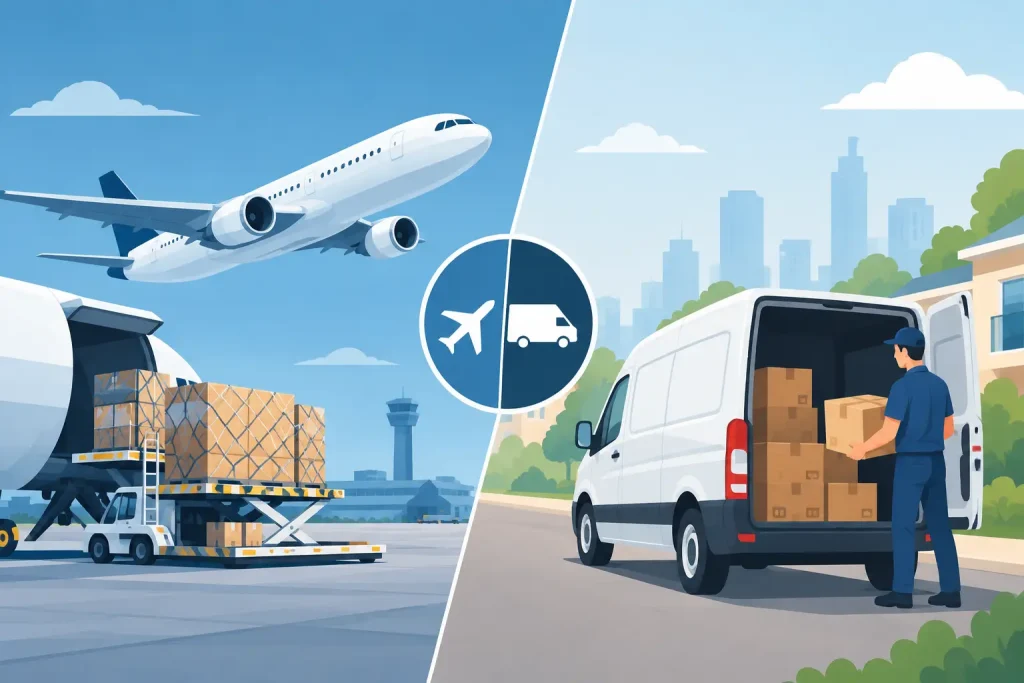
A production line waiting on a critical component, a retailer replenishing a fast-selling range, or an exporter meeting a fixed delivery date faces the same decision: air cargo versus courier. Both move goods by air and can be fast, but they operate differently in cost, handling, customs processes and the level of control available to the shipper.
Choosing the wrong option can mean paying courier rates for freight that should have travelled as consolidated cargo, or selecting airport-to-airport freight without allowing for the local delivery and clearance support required at each end. The right choice depends on the shipment, the deadline and how much of the transport task needs to be managed.
Air Cargo Versus Courier: The Core Difference
Courier services are designed around small, time-sensitive consignments moving through an integrated network. A courier generally collects from the sender and delivers directly to the consignee, with tracking and standardised processes built into the service. Documents, samples, replacement parts, small parcels and urgent e-commerce orders are typical courier shipments.
Air cargo is a freight forwarding service built for commercial consignments that travel on passenger or dedicated freighter aircraft. It is commonly airport-to-airport, although a freight forwarder can coordinate collection, export handling, customs clearance, destination cartage and final delivery as part of an end-to-end movement. Air cargo is more flexible for larger, heavier, irregular or higher-volume freight.
The distinction is not simply speed. A courier shipment may have an advantage for a small parcel because its network is designed to minimise handovers. For several cartons, a palletised consignment or cargo requiring tailored handling, air freight often provides better commercial value and more practical transport options.
When a Courier Service Makes Sense
Courier is usually the practical choice when the consignment is compact, straightforward and urgently required at a known delivery address. It offers a convenient door-to-door model, particularly where the sender does not need a customised collection, packing, clearance or delivery plan.
The appeal is administrative simplicity. Consignments are normally booked against a standard service level, labels are generated through the carrier system, and tracking follows the parcel through the network. For low-volume shipments, this can be more efficient than arranging separate origin transport, airline handling and destination delivery.
Courier services are often well suited to commercial samples, signed documents, medical or technical parts, small product launches and warranty replacements. They can also work well for recurring lightweight parcels where predictable dimensions allow costs to be monitored closely.
However, the quoted price needs to be assessed carefully. Couriers charge using actual weight or volumetric weight, whichever is greater. A light but bulky carton can therefore cost considerably more than expected. Remote-area surcharges, fuel charges, dangerous goods restrictions, oversize limits and destination duties can also change the final cost.
Where Air Cargo Provides Better Control
Air cargo becomes more compelling as freight grows in weight, volume or operational complexity. It allows shippers to choose service levels, airlines and routing options based on the actual needs of the consignment rather than fitting freight into a parcel network.
For example, a Melbourne importer receiving 12 cartons of retail stock may find that courier pricing becomes uneconomic once volumetric weight is applied. A consolidated air cargo service can provide a more suitable rate, while still meeting a commercially acceptable transit window. The same applies to machinery parts, textiles, flooring samples, electronics, trade equipment and inventory required to prevent a stockout.
Air cargo also supports a wider range of freight profiles. Subject to airline acceptance and applicable regulations, it can accommodate palletised freight, longer pieces, heavier cargo and carefully managed dangerous goods. It is not limited to what can pass through a standard courier sorting operation.
A freight forwarder can coordinate the full movement around the flight. This may include collection from the supplier, export documentation, security screening, airline booking, customs brokerage, airport collection, quarantine coordination where required, delivery booking and warehousing. That control is valuable when a shipment has several stakeholders, special handling instructions or a fixed site delivery requirement.
Cost: Compare the Whole Movement, Not the Headline Rate
A low air freight rate does not automatically make air cargo cheaper, and a high-looking courier quote is not always poor value. The meaningful comparison is the landed transport cost and the operational risk attached to it.
Courier rates often bundle collection, linehaul, clearance administration and final delivery into one charge. This makes small shipments easy to budget for, provided the dimensions and commodity are accurately declared. Air cargo rates may be quoted with separate charges for origin handling, terminal fees, security, customs clearance, destination handling and local cartage. These charges are not a drawback when they reflect services the shipment genuinely requires, but they must be visible before booking.
Australian importers should also separate transport cost from government charges. Duty, GST and other applicable taxes are determined by the goods, their value, origin and tariff classification, not by whether they arrive with a courier or as air cargo. Customs documentation must be accurate in either case, and some commodities can require permits or biosecurity assessment.
For regular freight, reviewing costs by chargeable weight, shipment frequency and delivery location will produce a clearer decision than comparing a single consignment. A business sending three urgent parcels each week may be able to consolidate some freight into scheduled air cargo while reserving courier for genuinely critical orders.
Speed Depends on More Than Flight Time
Courier is frequently the fastest option for small consignments, especially on major international lanes with daily network movements. Yet the advertised transit time should be treated as a guide, not an absolute guarantee. Cut-off times, export clearance, airline capacity, weather, screening and destination processing can all affect delivery.
Air cargo can be equally effective when planned properly. Priority services, direct routing and pre-arranged clearance can reduce delays, while consolidated services offer a more economical option where the delivery deadline has some flexibility. For many commercial shipments, saving one day at a significant premium is not the best outcome if the goods can arrive reliably within a two-to-four-day window.
The key question is not simply, “What is the fastest service?” It is, “When must the goods be available for use, sale or installation?” Working backwards from that requirement allows time for collection, documentation, customs and final delivery rather than focusing only on departure and arrival times.
Customs, Compliance and Cargo Information
Both courier and air cargo shipments entering Australia are subject to customs and biosecurity requirements. A courier may handle routine clearance within its service model, but the importer remains responsible for providing correct commercial information. Incomplete invoices, vague goods descriptions or incorrect values can result in delays, additional requests or penalties.
Air cargo movements are usually better suited to freight requiring more active compliance management. This includes shipments with multiple tariff lines, commercial quantities, controlled goods, timber or plant-based materials, machinery with contamination risk, or cargo that needs a formal customs entry. A freight forwarder and customs broker can review documentation before departure and coordinate issues before they become a costly hold at the border.
Accurate information should be available before either service is booked: the seller and buyer details, clear product descriptions, quantities, country of origin, commercial value, Incoterms, package dimensions, gross weight and any dangerous goods details. For Australian importers, this information is central to predictable clearance and cost control.
A Practical Decision Framework
Before selecting air cargo or courier, assess the freight against five commercial questions:
- Is the shipment small enough that courier volumetric pricing remains competitive?
- Does the freight need direct door-to-door delivery, or can collection and delivery be separately coordinated?
- Are the goods oversized, palletised, high-value, regulated or otherwise unsuitable for a standard parcel network?
- Is the deadline genuinely urgent, or can freight be consolidated into a lower-cost service?
- Will the shipment require formal customs, biosecurity or specialised handling support?
Courier generally wins when simplicity and parcel-level speed matter most. Air cargo is commonly the stronger choice when shipment size, cost efficiency, specialised handling or end-to-end freight coordination becomes more important.
For businesses managing recurring imports or exports, the best approach is usually not to choose one mode for every shipment. It is to build a freight plan that uses courier for exceptional urgency and air cargo for the commercial movements that need greater capacity, visibility and control. MCC World International can assess the cargo profile, route and compliance requirements before freight is committed, helping businesses make a decision based on total supply chain performance rather than a headline transit time.