
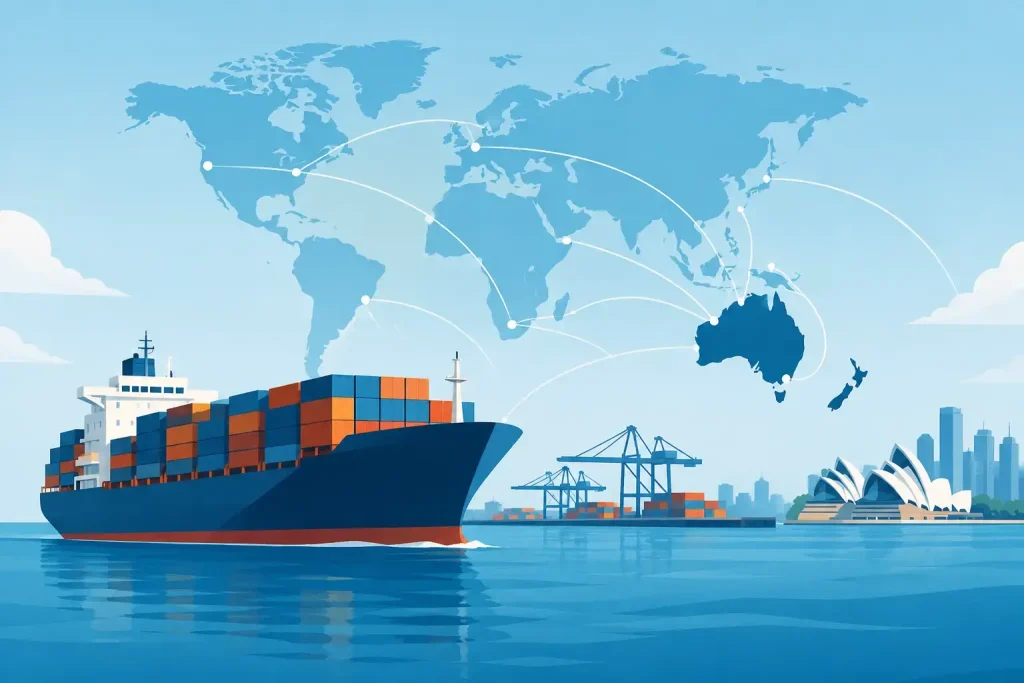
A container arriving late at Port Melbourne can affect far more than a delivery date. It can interrupt production, leave retail shelves short, trigger storage costs and force expensive domestic transport changes. For Australian importers and exporters, global shipping trends are no longer background market news. They are operating conditions that need to be factored into purchasing, inventory and freight planning.
The most successful businesses are not trying to predict every disruption. They are building supply chains that can respond when vessel schedules move, capacity tightens or border requirements change. That requires clear freight visibility, realistic lead times and coordination across sea, air, road, customs and warehousing.
Global Shipping Trends Affecting Australian Businesses
Schedule reliability remains a planning issue
Ocean freight remains the most cost-effective option for many Australian cargo movements, particularly for full container loads, heavy machinery, retail freight and bulky goods. However, advertised transit times and actual arrival dates are not always the same. Port congestion, weather, blank sailings, transhipment delays and equipment imbalances can all change a shipment’s timeline after booking.
Australia’s distance from major manufacturing markets adds another layer of exposure. A delay at an overseas hub can flow through to a missed connection, late discharge or unavailable cartage slot in Australia. Businesses should therefore plan around delivery windows rather than a single fixed arrival date, especially where stock is needed for promotions, construction programs or seasonal demand.
This does not mean sea freight is unreliable. It means freight planning needs sensible time buffers and active shipment monitoring. A forwarder that can communicate changes early gives operations teams more options to adjust receiving schedules, labour and inventory allocation.
Freight rates are more variable than many budgets allow for
Freight costs can change quickly in response to capacity, fuel prices, port productivity, trade demand and disruptions on key shipping lanes. Rates may also vary between direct services and transhipment routes, container types, carrier equipment availability and seasonal demand.
For Australian businesses, the landed cost is what matters. The ocean or air freight charge is only one part of the equation. Origin handling, terminal charges, customs clearance, duty, GST, quarantine requirements, storage, demurrage, detention and local delivery all influence the final cost of moving goods.
The practical response is not simply to choose the lowest quoted freight rate. It is to compare like-for-like service scopes and confirm which charges apply at origin and destination. Transparent quoting supports better purchasing decisions and reduces the risk of unexpected costs once cargo reaches Australia.
Air freight is being used more selectively
Air freight remains essential for urgent replenishment, high-value products, spare parts and time-critical project cargo. Yet its cost means it is increasingly being used as a targeted supply-chain tool rather than a default transport mode.
Many businesses are splitting shipments by priority. Core stock may travel by sea, while a smaller quantity of fast-moving lines or production-critical components travels by air. This can protect sales or prevent downtime without moving an entire order at premium air freight rates.
The trade-off is coordination. Split consignments need accurate documentation, customs treatment and receiving plans so that the air component does not create confusion when the balance arrives by sea. For urgent cargo, flight capacity, dimensional weight and security screening can also affect both price and timing.
Compliance is becoming more operationally significant
Customs and border compliance has always been central to international trade, but it is increasingly linked to supply-chain performance. Incorrect tariff classification, incomplete commercial invoices, inaccurate packing lists or missing permits can delay a shipment at the point it matters most.
Australian importers must also consider biosecurity obligations. Products such as timber, food-related goods, machinery, used vehicles, textiles and goods with soil contamination can require additional assessment or treatment. The requirement depends on the product, country of origin, packaging and cargo condition.
Exporters face their own documentation and destination-country requirements. A freight plan should allow time for customs declarations, permits, certificates and any product-specific controls before cargo reaches the terminal. Treating compliance as an end-of-process task is a costly mistake when cut-off times are approaching.
Why Supply Chain Flexibility Matters More
A single-mode freight strategy can work when demand is stable and timing is forgiving. It becomes less effective when stock is time-sensitive, cargo is oversized or a shipment has several handovers between suppliers, ports, warehouses and final customers.
Multimodal planning gives businesses more practical choices. Cargo might move by sea into Melbourne, clear customs, transfer to a warehouse for unpacking and then be distributed by road across Victoria or interstate. A project shipment may need specialised handling at origin, breakbulk or containerised sea freight, port coordination and heavy-haul delivery at destination.
The best solution depends on the cargo and commercial objective. Sea freight may minimise unit cost, while air freight protects a deadline. Holding more safety stock may improve continuity, but it increases warehousing and working-capital costs. Direct delivery can reduce handling, while short-term warehousing may make distribution more controlled. There is no universal answer, which is why freight decisions should be made against the realities of each supply chain.
Inventory strategies are shifting from lean to considered
For years, many businesses prioritised lean inventories and just-in-time replenishment. That approach can still be effective for predictable lanes and dependable suppliers. However, extended transit uncertainty has prompted more importers to carry buffer stock for essential products, fast-moving lines and long-lead components.
The goal is not to fill a warehouse without a plan. It is to identify where a stockout would cause the greatest commercial damage and set inventory levels accordingly. A retailer may protect best-selling product lines before slower-moving ranges. A manufacturer may prioritise parts that would stop production. An importer of flooring, furniture or tiles may need to account for longer replenishment cycles and container utilisation.
Warehousing and distribution should be considered alongside international freight. Cargo that arrives ahead of immediate demand needs secure storage, accurate stock control and a clear delivery plan. Cargo that arrives late may need priority unpacking and allocation to high-value orders.
Practical Actions for Importers and Exporters
Businesses do not need to overhaul their supply chain every time a freight market changes. They do need a disciplined process for reviewing risk and making decisions before cargo becomes urgent.
Start by mapping the full movement of key products, from supplier collection through to final delivery. Identify the points where delays, cost increases or compliance issues are most likely to affect operations. For many businesses, the greatest exposure is not the ocean transit itself but missed documentation cut-offs, poor visibility after arrival or insufficient time allowed for customs and local delivery.
Next, set clear service expectations with suppliers and logistics providers. Confirm when cargo will be ready, which Incoterms apply, who controls the booking, what documentation is required and what delivery date is genuinely needed. A supplier saying goods are ready does not necessarily mean they are packed, compliant and available for collection.
It is also sensible to review freight performance by lane. Compare planned and actual transit times, delivery outcomes, accessorial charges and recurring exceptions. This information helps distinguish a one-off disruption from an underlying service issue that needs a different routing, carrier or inventory plan.
For complex movements, a single operational point of contact can reduce fragmentation. MCC World International coordinates international freight, customs clearance, cartage, warehousing and distribution so Australian businesses can manage the shipment as one connected process rather than a series of separate handovers.
Planning for the Next Shipment
Global shipping conditions will continue to change, and not every change will be predictable. The businesses that manage this well are those that turn freight information into practical decisions early: book before capacity becomes tight, prepare documents before cut-off, allow realistic time for border processes and keep alternative transport options available for critical cargo.
Before placing the next purchase order, test the freight plan against the consequences of a delay. If the answer exposes a gap in stock, compliance, delivery capacity or cost control, that is the right time to adjust the plan – while there are still options available.