
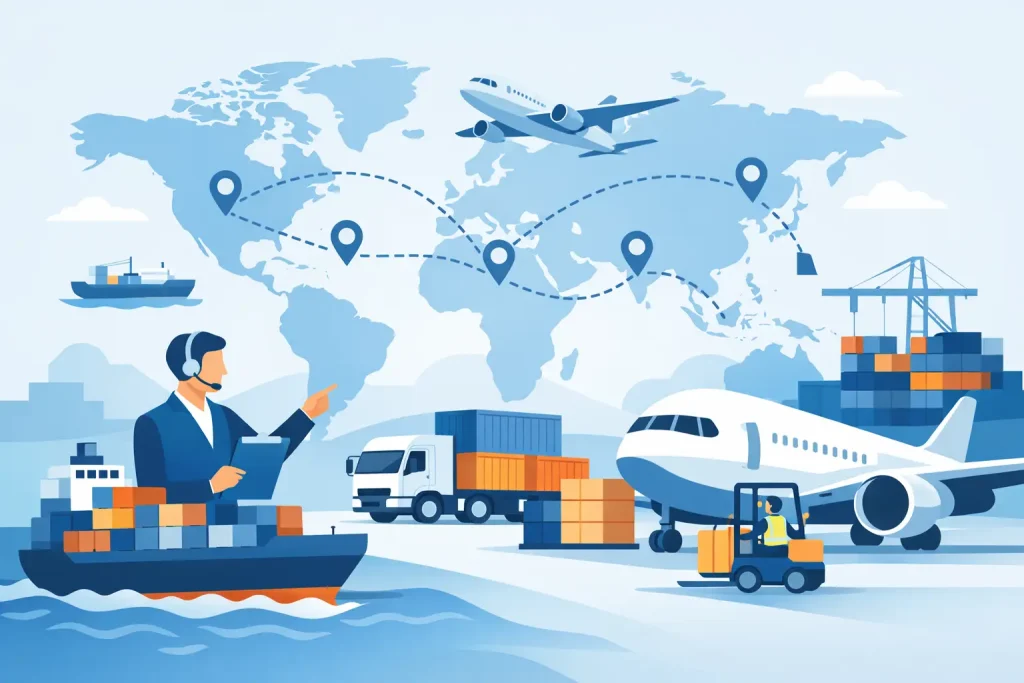
A delayed container in Singapore, a customs query in Melbourne, and a delivery booking that misses a warehouse slot by half a day – this is where many shipments stop being simple. If you are asking what is global freight forwarding, the practical answer is this: it is the coordination layer that keeps international cargo moving from supplier to consignee without your business having to manage every carrier, document, regulation and handover itself.
For Australian importers and exporters, freight forwarding is not just about booking space on a vessel or aircraft. It is about controlling risk, cost, timing and compliance across multiple legs of a shipment. That matters even more when cargo is moving into Australia, where border requirements, biosecurity controls, port processes and inland transport all need to line up.
What is global freight forwarding in practical terms?
Global freight forwarding is the management of international cargo movements across countries, transport modes and supply chain touchpoints. A freight forwarder acts as the party that plans, coordinates and oversees the movement of goods by sea freight, air freight, road transport and, where required, warehousing and distribution.
In simple terms, a freight forwarder does not usually manufacture goods or operate as the final buyer or seller of the cargo. Instead, the forwarder manages the shipping process on behalf of the cargo owner. That can include arranging collection from the supplier, booking freight capacity, preparing shipping documents, coordinating customs clearance, managing local cartage and organising delivery to the final destination.
This role becomes more valuable as shipments become more complex. A straightforward carton shipment by air still needs accurate paperwork and customs handling. A container of retail goods needs scheduling, documentation and delivery coordination. Oversized machinery or project cargo requires route planning, specialised equipment and close control at every handover.
What does a global freight forwarder actually do?
A global freight forwarder brings multiple services into one managed process. That starts before the goods even leave the supplier. The forwarder may review the cargo details, packing method, dimensions, weights, origin point, destination requirements and preferred transit timeframe. From there, the shipment is matched to the most suitable mode and route.
Sea freight is often the right fit when cost control matters more than speed, particularly for larger volumes. Air freight is usually chosen when time is critical, stock levels are tight or the cargo has a high value relative to its size. In many cases, neither mode works on its own. Goods may move by sea internationally, then by road domestically, with warehousing in between. That is where multimodal planning matters.
Freight forwarders also manage documentation. This may include commercial invoices, packing lists, bills of lading, air waybills, import declarations, export declarations and supporting compliance documents. If the paperwork is inaccurate, cargo can be delayed, re-examined or held at the border.
Customs clearance is another key function. For Australian businesses, this is not a minor administrative step. It is a compliance process that affects duty, GST, permits, biosecurity controls and release timing. A capable freight partner helps make sure goods are classified correctly, declarations are lodged accurately and border issues are addressed quickly.
On top of that, a forwarder may arrange insurance options, container unpacking, storage, final mile delivery and ongoing shipment tracking. The value is not one individual service. It is the fact that those services are coordinated as one chain rather than managed through separate providers with separate accountabilities.
Why businesses use freight forwarding instead of booking directly
Some importers assume global shipping is simply a matter of dealing directly with a shipping line or airline. In reality, direct booking only covers one part of the task. It does not remove the need to manage origin handling, destination charges, customs entries, transport scheduling, container availability, delivery bookings or exceptions when something changes in transit.
That is why global freight forwarding is often more efficient than piecing together the process yourself. Businesses use forwarders to reduce administrative load, improve shipment visibility and avoid the cost of mistakes. This is especially relevant for SMEs and growing importers that need dependable logistics without maintaining a large internal shipping team.
There is also a commercial advantage. Freight decisions affect landed cost, stock availability and customer service performance. Choosing the wrong mode, accepting unclear charges or missing a compliance requirement can turn a low freight rate into an expensive shipment.
What is global freight forwarding for Australian businesses?
For Australian businesses, what is global freight forwarding really about? It is about managing international trade into a market that depends heavily on coordinated shipping and inland logistics.
Australia’s geography makes transport planning more sensitive to timing, vessel schedules and domestic delivery networks than many overseas markets. Cargo arriving at a major port still needs to reach warehouses, retail locations, project sites or regional destinations. Delays at the port can flow directly into stock shortages, missed installs or production disruptions.
Imported goods also face specific Australian border and biosecurity requirements. Depending on the cargo, there may be inspections, permits or treatment requirements that need to be handled correctly. Exporters face their own pressures, especially when shipping time-sensitive products or meeting customer delivery windows overseas.
That means Australian shippers benefit from a freight partner that understands both international forwarding and local execution. Global reach matters, but so does practical control on the ground in cities such as Melbourne, Sydney, Brisbane, Perth and Adelaide.
Where freight forwarding adds the most value
Freight forwarding is useful for almost any international shipment, but its value becomes clearer in certain situations. One is when cargo has multiple handovers. The more parties involved, the greater the risk of delays, miscommunication or missing documents.
Another is when the goods are specialised. Heavy machinery, oversized cargo, vehicles, furniture, tiles, textiles and retail freight all come with different handling, packing and transport requirements. A standard shipping process does not suit every commodity.
It also matters when businesses are scaling. A shipment that was manageable once a quarter becomes harder to control when imports arrive weekly across different suppliers and ports. At that point, freight forwarding supports supply chain continuity, not just transport booking.
Forwarding also becomes critical when timelines are commercially sensitive. If late freight means an empty showroom, delayed store replenishment or downtime on a project site, transport coordination has a direct business cost.
Freight forwarding is not one-size-fits-all
Not every shipment needs the same service model. That is one of the most important things businesses should understand.
A low-urgency FCL sea freight movement can be planned around vessel schedules and cost efficiency. An urgent air shipment might justify a higher rate because it protects sales or production. Consolidation may reduce cost for smaller consignments, but it can also add handling stages and potentially extend transit time. Warehousing can solve timing mismatches between arrival and delivery, though it adds storage and handling charges.
The right freight plan depends on the cargo, the delivery deadline, the budget, the destination and the level of supply chain risk your business can tolerate. Good freight forwarding is not about forcing every shipment into the same pathway. It is about building the right pathway for the shipment.
How to choose the right freight forwarder
If you are selecting a freight partner, look beyond headline freight rates. A low upfront quote does not mean much if the service excludes key charges, misses compliance risks or leaves you chasing updates when cargo is delayed.
A reliable global freight forwarder should be able to explain routing options clearly, outline realistic transit expectations and identify the likely pressure points before the shipment moves. Transparency matters. So does local market knowledge, especially for import clearance and delivery coordination in Australia.
It is also worth assessing service breadth. If your freight provider can support customs clearance, transport, warehousing and distribution as part of one managed solution, your business has fewer moving parts to control. That usually leads to better accountability and faster problem resolution.
For businesses moving specialised cargo, industry experience matters even more. Not every provider is equipped to handle project cargo, vehicles or oversized freight with the same level of planning and compliance control.
MCC World International works with Australian businesses that need this kind of end-to-end coordination – not just a booking service, but practical control across freight, customs and local delivery.
The real purpose of freight forwarding
At its best, global freight forwarding gives businesses more than transport. It gives them a clearer chain of responsibility. Instead of trying to manage overseas suppliers, carriers, customs processes and local transport as separate tasks, they have a coordinated shipping strategy backed by operational expertise.
That is why the question is not only what is global freight forwarding. The better question is what happens to your business when freight is not managed properly. Delays, hidden costs, compliance issues and poor visibility all affect your margins and your customer commitments.
The right forwarding partner helps turn international shipping from a recurring disruption into a process your business can plan around with confidence.