
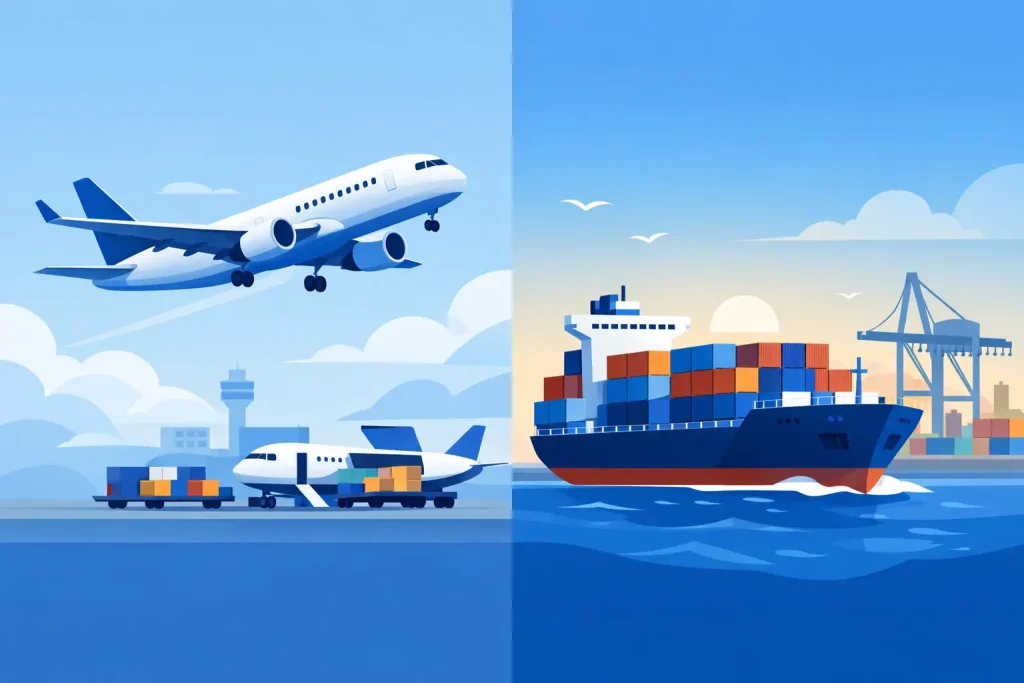
A delayed shipment can affect more than a delivery date. It can hold up production, leave shelves empty, push up storage costs, or create avoidable pressure on your customers. That is why the air freight vs sea freight decision matters. For Australian importers and exporters, the right choice depends on timing, cargo profile, landed cost, and how much flexibility your supply chain actually has.
There is no universal winner. Air freight is faster and often more predictable for urgent cargo, while sea freight is usually the better fit for larger volumes and tighter freight budgets. The commercial question is not which mode is better in general. It is which mode makes the most sense for this shipment, this route, and this deadline.
Air freight vs sea freight: the core difference
Air freight is built for speed. It is typically used when cargo needs to move quickly, whether that means replenishing stock, meeting a project deadline, moving high-value items, or reducing the impact of a supply chain disruption. Transit times are measured in days rather than weeks, which can make a major difference for time-sensitive freight.
Sea freight is built for capacity and cost efficiency. It suits businesses moving larger consignments, non-urgent goods, bulky cargo, or products where freight cost needs to be kept under control to protect margin. For many importers into Australia, sea freight remains the standard mode because it allows more volume to move at a lower cost per cubic metre or per kilo.
That difference sounds simple, but the real decision is usually shaped by several commercial factors at once.
Cost is rarely just the freight rate
The first reason many businesses compare air and sea is budget. On the base freight rate alone, sea freight is generally more economical than air freight. If you are moving heavy cargo, palletised stock, machinery, building materials, furniture, textiles, or retail inventory in meaningful volume, sea freight usually offers stronger value.
Air freight, by contrast, carries a premium. The faster transit and airport handling model come at a higher rate, especially for dense or bulky cargo. If a product has low margin and no urgency, air freight can quickly erode profitability.
But freight rate is only one part of the landed cost. Faster delivery can reduce warehouse pressure, lower the need for safety stock, and help avoid stockouts. If delayed freight causes lost sales or production downtime, a cheaper sea freight booking may turn out to be the more expensive option overall.
This is where practical planning matters. A business importing fast-moving retail lines may decide that sea freight works for forecasted stock, while selected SKUs move by air when demand spikes. A manufacturer waiting on one missing component may find that paying more for air freight is justified if it keeps operations running.
Transit times and schedule reliability
Speed is the obvious advantage of air freight, but reliability is often just as valuable. If your supply chain depends on consistent replenishment windows, shorter transit can reduce the risk of long delays cascading through your operations.
Air freight generally offers quicker terminal-to-terminal movement, but it is not immune to disruption. Flight capacity, security processes, dangerous goods restrictions, airport congestion, and transhipment issues can still affect transit. During peak periods, space can tighten quickly and rates can move with little notice.
Sea freight takes longer, and the longer the transit, the more exposure there is to schedule changes. Port congestion, blank sailings, weather, vessel rollovers, and container availability all play a role. For Australian cargo, route and port selection can also affect how efficiently freight moves once it arrives.
That does not mean sea freight is unreliable. It means it requires more lead time and stronger planning discipline. Businesses that forecast properly can use sea freight very effectively. Businesses that leave orders late often find themselves paying for air freight to correct a timing problem that could have been avoided earlier.
Cargo type changes the answer
The air freight vs sea freight decision should always reflect what you are shipping.
High-value, low-volume goods often suit air freight because the speed advantage is significant and the freight cost is easier to absorb as a percentage of cargo value. Electronics, urgent spare parts, samples, medical items, and critical replacement stock are common examples.
Larger, heavier, or less time-sensitive cargo usually suits sea freight. This includes machinery, oversized freight, furniture, flooring, tiles, textiles, and container-load retail stock. Sea freight also provides more flexibility for awkward dimensions and project cargo that would be costly or impractical to move by air.
Some commodities also face restrictions that affect mode choice. Dangerous goods, batteries, liquids, or specialised equipment may require specific handling and compliance steps. In those cases, feasibility is not just about cost or transit. It is about what can legally and safely move under airline or shipping line rules.
Volume and shipment size matter
If you are shipping a few cartons, air freight may be commercially realistic, especially when delivery time matters. If you are moving multiple pallets, full containers, or recurring bulk orders, sea freight becomes much harder to ignore from a cost perspective.
Shipment size also affects how freight is rated. Air freight charges can be based on actual weight or volumetric weight, depending on which is greater. That means light but bulky cargo can become expensive very quickly. Sea freight, particularly for containerised cargo, often provides better economics for bulky freight because the cost spread across volume is lower.
For businesses importing into Australia on a regular cycle, this often leads to a mixed-mode strategy. Core stock moves by sea, while urgent top-up freight moves by air only when needed. This approach can support service levels without placing the whole freight budget under pressure.
Customs, handling and end-to-end coordination
Mode selection should not be made in isolation from customs clearance, local cartage, warehousing, and final delivery. A shipment that arrives quickly but sits waiting on paperwork, inspection, or collection is not delivering the advantage you paid for.
Air freight can shorten international transit, but customs compliance remains critical. The same is true for sea freight, particularly where container unpacking, quarantine processes, or delivery slot requirements come into play. Australian importers need to consider documentation accuracy, tariff classification, duties, taxes, and the timing of each handover point.
This is where working with a freight partner that can coordinate the full movement matters. When freight, customs, cartage, and warehousing are planned together, the mode decision becomes more accurate. At MCC World International, this is often where the real value sits – not just booking cargo space, but aligning the shipment method with compliance, delivery timing, and downstream operations.
When air freight is the better option
Air freight usually makes sense when time has a direct commercial value. If a delayed shipment means missed sales, halted production, project overruns, or contractual issues, the higher freight cost may be justified.
It is also well suited to product launches, replacement parts, urgent replenishment, and high-value cargo where speed and shorter inventory cycles matter more than pure freight savings. For some businesses, air freight is not the normal mode, but it is an essential contingency tool when supply chains tighten.
The key is to use it deliberately. Air freight solves timing problems well, but it should not become a habit that hides weak forecasting or poor procurement timing.
When sea freight is the stronger commercial choice
Sea freight is usually the better fit when cost control, shipment volume, and planning stability are the priorities. If your goods are not urgent and your ordering cycle allows proper lead time, sea freight can support stronger landed margins and more scalable import volumes.
It is particularly effective for containerised imports, repeat purchase orders, wholesale inventory, heavy cargo, and project freight. It also gives businesses more room to consolidate cargo and plan around predictable supply cycles.
Where sea freight works best, however, is in businesses that treat logistics as part of procurement strategy rather than an afterthought. The more accurately you plan demand, supplier readiness, and arrival windows, the more value sea freight tends to deliver.
The best answer is often not either-or
For many Australian businesses, the smartest freight model is not choosing one mode and sticking to it. It is building a supply chain that uses both where they add value.
That might mean sea freight for regular inbound stock and air freight for urgent exceptions. It might mean using air for launch quantities, then shifting to sea once volume stabilises. It might mean splitting a shipment so critical items arrive first and the balance follows at a lower cost.
This kind of planning gives businesses more control over cash flow, inventory risk, and customer service. It also reduces the chance of reactive freight decisions made under pressure.
If you are weighing up air freight and sea freight, start with the commercial outcome you need, not just the rate sheet. The right mode is the one that supports your delivery promise, protects margin, and keeps the wider supply chain moving without unnecessary risk. That is usually where the strongest freight decision is made.