
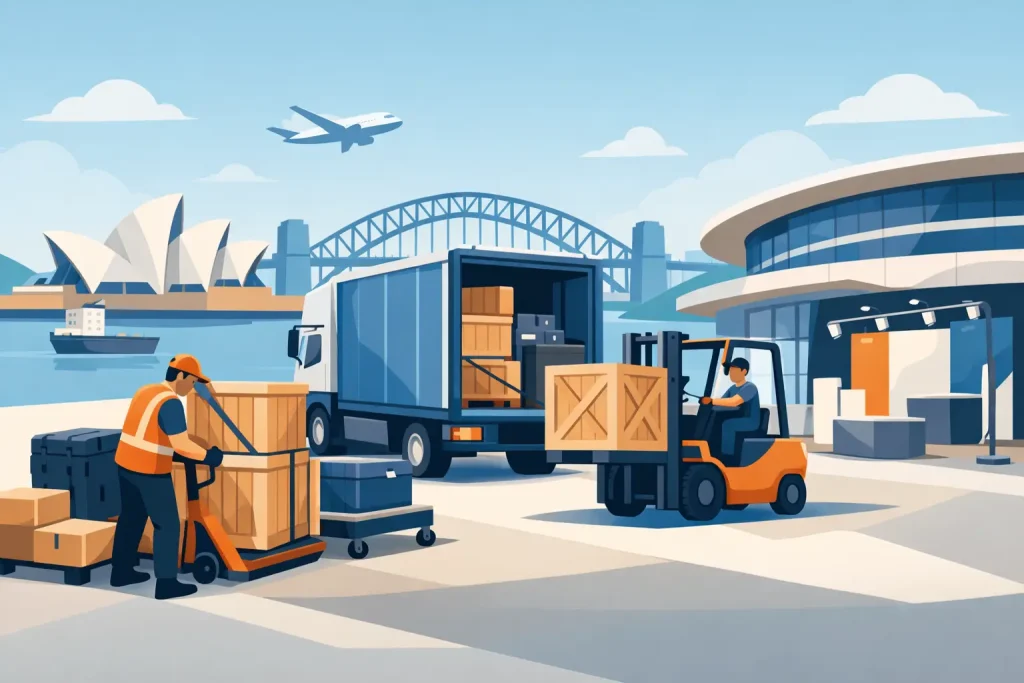
Miss your booth delivery window by a few hours, and the problem is rarely just freight. Exhibition cargo affects stand build timing, labour bookings, customs clearance, storage fees, site access and, ultimately, whether your team is ready when doors open. For Australian businesses exhibiting locally or overseas, that makes logistics planning a commercial decision, not an admin task.
Exhibitions run on fixed dates, fixed venues and fixed access rules. Unlike standard freight, there is very little room to recover if cargo arrives late, is held at customs or is delivered without the documentation a venue or organiser requires. The pressure point is not only transit. It is coordination across every step before, during and after the event.
What makes exhibition cargo different
Most commercial freight can tolerate a degree of flexibility. Exhibition cargo usually cannot. A delayed pallet for warehouse stock may be inconvenient. A delayed shipment for a trade show can mean an incomplete stand, missed product demonstrations and a poor first impression in front of buyers, distributors or project stakeholders.
That is because exhibition shipments often involve multiple moving parts at once. You may be sending display materials, printed graphics, electronics, furniture, samples, marketing stock and demonstration units in one consignment. Some items are high value, some are fragile, and some may need temporary import treatment rather than a standard permanent entry.
Venue restrictions add another layer. Many exhibition centres operate on strict bump-in and bump-out schedules, booked loading docks and narrow delivery windows. If cargo arrives outside the permitted period, it may be refused, redirected to holding storage or subject to additional handling charges. That is where specialist planning matters.
Timing is the first risk to control
The most common issue with exhibition cargo is assuming the event date is the delivery date. In reality, the critical date is usually the required on-site handover time, which can sit days earlier depending on stand construction, testing and organiser deadlines.
Air freight can reduce line-haul transit time, but it does not remove customs processing, terminal handling, final-mile delivery or venue access constraints. Sea freight may be more cost-effective for larger stands or bulky display material, but it requires more buffer for sailing schedules, port delays and unpack timing. The right mode depends on cargo type, event location, budget and the cost of failure.
For many exhibitors, the sensible approach is to work backwards from stand-ready time rather than departure date. That includes allowing time for document review, export packing, international transit, customs formalities, unpacking and any re-labelling or site-specific handling.
Why buffer time matters more than speed
Fast freight is useful. Predictable freight is better. Exhibition programmes leave little tolerance for missed milestones, so building in contingency is often more valuable than choosing the quickest transit option on paper.
A shipment that arrives two days early and sits in planned storage is usually manageable. A shipment that lands on the final day but cannot clear or be delivered before dock cut-off is not. This is where experienced freight coordination protects both cost and outcome.
Customs and compliance can decide the whole job
International exhibition cargo often falls into a grey area for inexperienced shippers. Is the cargo being sold at the event, displayed only, returned after the show, or partially distributed to customers? Each scenario can affect customs treatment, duties, taxes and documentation requirements.
Temporary imports can be useful for exhibition goods that will return to origin after the event, but they are not automatic. The paperwork must align with the shipment purpose, item descriptions, values and return intentions. If samples are to be consumed, given away or sold, that can change the compliance position.
Australian exhibitors also need to consider what they are shipping. Timber packaging may require treatment compliance. Electrical items may attract inspection or additional declarations depending on destination requirements. Promotional products, food samples, cosmetics or regulated materials can trigger controls that do not apply to ordinary display panels or printed signage.
Errors here are expensive because customs delays do not care about your exhibition opening time. A missing declaration, poor commodity description or incorrect invoice value can stop cargo at the border and create storage, inspection and rework costs on top of the delay itself.
Packaging needs to match the venue reality
Exhibition cargo is handled more than many businesses expect. It may move from your premises to a depot, then to an airport or port, then through destination handling, customs examination, a temporary storage point, a site marshalling area and finally the stand itself. That chain creates repeated handling risk.
Packaging should be built for transport mode and site conditions, not just for dispatch. Custom crates are often worthwhile for reusable stand elements, lighting, screens and fragile components. Clearly marked cartons can work for printed materials and lower-risk items, but only if they are labelled accurately and packed to withstand stacking and movement.
Return logistics also matter. If the same materials are coming back after the event, packaging should be reusable and easy to re-pack under time pressure. Too many exhibitors focus only on bump-in and then discover their outbound packaging was destroyed, discarded or impossible to rebuild during bump-out.
Inventory control is not optional
At exhibition level, vague packing lists create avoidable problems. If one crate holds screens, brochures, branded panels and power leads together, a delayed inspection or misplaced carton can hold up the whole stand.
A proper inventory should identify each package, dimensions, weight, contents and priority. That makes customs review easier, site receiving more accurate and return reconciliation far less painful. It also helps separate what must arrive first from what can follow later if required.
On-site delivery is where planning becomes visible
Even when the line-haul movement is executed well, final delivery to the exhibition venue can still fail. Exhibition centres often require pre-booked dock times, specific vehicle types, driver registration, site induction or use of approved material handling teams. Standard courier assumptions do not apply.
This is why exhibition cargo should be managed as a door-to-stand exercise, not merely port-to-port or airport-to-airport. The final handover point matters. So does the chain of custody between warehouse, venue and exhibitor team.
For interstate and international exhibitors attending Australian events, local knowledge is especially useful. Access conditions vary across venues in Melbourne, Sydney, Brisbane, Perth and Adelaide. Delivery timing, cartage restrictions and labour arrangements are not always consistent. A logistics partner with local transport and site coordination experience can remove a great deal of friction from that final stage.
Cost control is about preventing the wrong charges
Businesses often compare exhibition freight on line-haul price alone. That can be misleading. The real cost exposure tends to sit in exceptions such as storage, demurrage, customs intervention, after-hours delivery, re-delivery, venue handling, unpacking delays and emergency replacement freight.
The cheapest quote can become the most expensive outcome if the service scope is too narrow. Exhibition cargo needs clarity around what is included – collection, export packing, customs clearance, temporary storage, final-mile delivery, waiting time, return freight, and support during bump-out. Without that detail, budgeting is incomplete.
It also depends on the value of the event itself. If the exhibition supports a product launch, dealer engagement or major sales pipeline, paying for tighter control may be commercially sensible. If the stand is simple and the cargo low risk, a leaner model may work. The right answer depends on the consequence of delay.
Choosing the right logistics support
A general freight model is not always enough for exhibition work. The job usually benefits from coordination that covers international forwarding, customs, local cartage, warehousing and time-critical delivery in one plan.
That is particularly relevant for Australian businesses managing multi-leg movements or mixed cargo types. If display materials arrive separately from samples, printed assets and equipment, someone needs to control the sequence, documentation and final consolidation. This is where an end-to-end provider such as MCC World International can add practical value – not by moving a single shipment in isolation, but by managing the full freight pathway around the event timeline.
Ask direct questions before booking. Who is responsible for customs documents? What is the latest safe dispatch date? Where will cargo sit if it arrives early? Who books venue delivery? How are return goods packed and collected? If those answers are vague, the risk sits with you.
A smarter way to approach exhibition cargo
The businesses that handle exhibition logistics well usually treat the event as an operations project with a deadline, not as a one-off freight booking. They plan backward from stand readiness, document every item properly, choose packaging that survives repeated handling, and align transport with venue rules rather than hope for the best.
That approach does not remove every risk. Weather, inspections and schedule changes can still happen. What it does is reduce the number of avoidable failures. And when your cargo is tied directly to customer-facing activity, that level of control is worth far more than a rushed fix at the venue dock.