
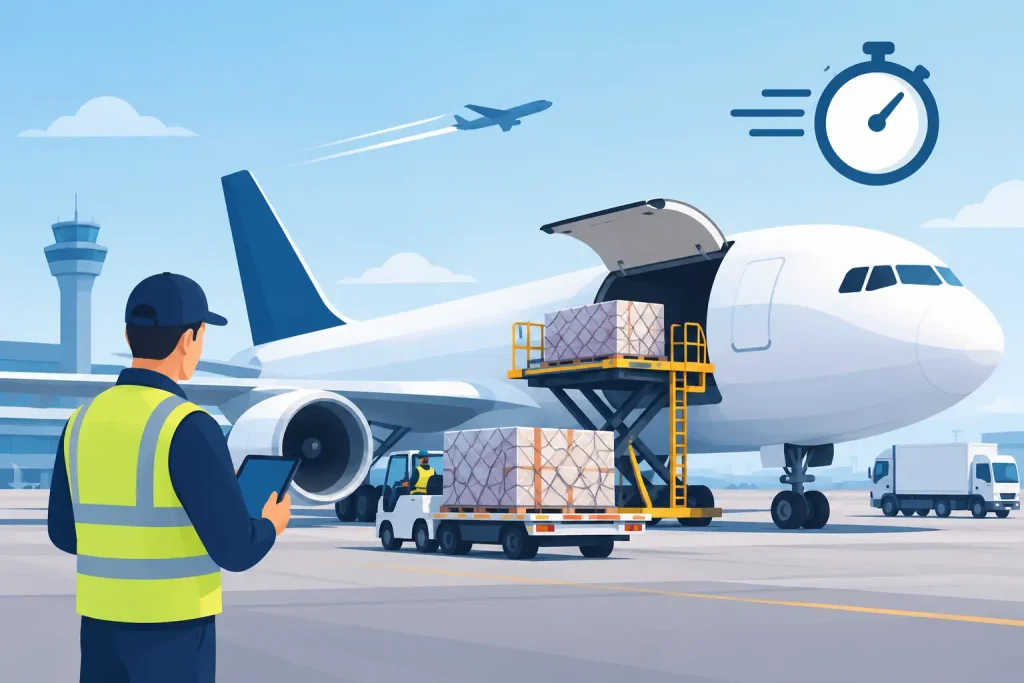
A production line waiting on one component, a retail launch with stock held offshore, or a critical machine part needed at a regional site can quickly turn freight into a business continuity issue. When you need to book urgent air freight, speed matters, but so do accurate documents, cargo readiness and a realistic plan for the full movement from collection through to final delivery.
Urgent air freight is not simply standard air cargo with a faster label. Capacity, airline cut-off times, security screening, customs requirements and local cartage all affect whether a shipment moves on the intended flight. The strongest outcome comes from treating the booking as an end-to-end operational task, not just an airport-to-airport transaction.
When urgent air freight is the right option
Air freight is generally suited to high-value, time-sensitive or business-critical cargo where the cost of delay is greater than the higher transport cost. This may include replacement machinery parts, medical or technical equipment, samples, electronics, urgent retail replenishment and items required for project deadlines.
The decision should be based on the required delivery date, not only the flight departure date. A shipment can land in Melbourne, Sydney or another Australian gateway quickly but still lose time if import declarations, permits, inspections or delivery bookings have not been planned. For exports, the same principle applies: collection, packing, export clearance and terminal receival must be completed before the airline’s cut-off.
Air freight may not be the best solution where cargo is bulky but low in value, where the deadline allows for sea freight, or where the goods are not ready to ship. Airfreight is normally charged by whichever is greater: actual weight or volumetric weight. A large, light consignment can therefore cost considerably more than its scale weight suggests. In some cases, a split shipment is the more commercial answer, with urgent stock sent by air and the balance moving by sea.
What to have ready before you book urgent air freight
The fastest bookings begin with complete and correct information. Providing only a collection address and a request for the next available flight leaves too many variables unresolved, particularly when airlines are managing tight capacity.
Your freight provider will need the collection location, destination, final delivery address, commodity description, number of packages, dimensions, actual weight and date the cargo will be ready. It is also useful to state the latest acceptable delivery time rather than simply asking for the fastest service. This allows the routing and service level to be selected against the commercial requirement.
For international shipments, prepare the commercial invoice and packing list early. The invoice should clearly identify the seller, buyer, goods, quantity, currency, Incoterms and country of origin where applicable. Vague descriptions such as “parts”, “samples” or “equipment” can lead to customs queries. A precise description, for example “stainless-steel hydraulic valve for industrial machinery”, gives customs authorities and carriers a clearer basis for assessment.
Certain goods require further checks before booking. Batteries, liquids, aerosols, chemicals, magnets and other regulated commodities may be classified as dangerous goods or may be restricted for carriage by air. Timber products, food, plant-based materials and selected machinery can also require biosecurity attention on arrival in Australia. Do not assume an item is acceptable because it has travelled by road or sea before. Air transport rules and airline acceptance criteria can differ.
Confirm the cargo is physically ready
A confirmed flight cannot compensate for freight that is unlabelled, poorly packed or not available at the agreed collection time. Cartons and crates should be suitable for airport handling, with package dimensions and weights matching the booking details. Any discrepancy can affect the rate, the airline acceptance process or the space allocation.
Where cargo is oversized, fragile or requires special handling, advise this at the outset. The booking may need specialised equipment, a different aircraft type, an approved crate, priority terminal arrangements or a tailored road transport plan. Early visibility gives the forwarder more options and reduces the risk of a last-minute rework.
Selecting the right level of urgency
Not every urgent shipment needs the highest-priced service. The right solution depends on how firm the deadline is, whether a direct flight is available, and how much flexibility the business has if capacity changes.
A next-flight or priority service is appropriate where downtime, contractual exposure or a fixed event date makes delay unacceptable. It usually receives stronger booking priority, but it can still be subject to operational disruption such as weather, aircraft changes or security restrictions. A deferred air freight service can be suitable for shipments that need to move promptly but have a few days of tolerance, often offering a better balance between transit time and cost.
Direct routes are usually preferable for critical cargo because they reduce handling points. However, a connection can sometimes provide earlier uplift or better capacity. The best routing is therefore not always the shortest on a timetable. It is the routing that has confirmed space, workable connection times, correct documentation and a reliable final-mile plan.
Customs clearance and compliance cannot wait
For cargo entering Australia, customs and biosecurity processes should be considered at the same time as the transport booking. Depending on the goods and shipment value, an import declaration, permits, treatment evidence or inspection arrangements may be required. Delays commonly occur when documents do not match the cargo, tariff classification is unclear, or biosecurity risks are identified after arrival.
For exports, the exporter must ensure the goods can legally leave Australia and that all supporting documentation is available. This can include export declarations, certificates of origin, permits or destination-country requirements. If the shipment is moving under a letter of credit or to a customer with strict document instructions, those requirements should be reviewed before the airway bill is issued.
An experienced freight forwarder coordinates these elements alongside the flight movement. MCC World International can manage air freight, customs clearance, collection and delivery as a connected process, giving businesses one operational point of contact rather than separate providers at each stage.
Build final delivery into the booking plan
Airport arrival is not the same as delivery. Once the freight is available, it may need to be cleared, collected from the terminal, transferred to a depot or delivered to a site with restricted access or booking windows. This is especially relevant for hospitals, retail distribution centres, construction sites, regional facilities and secure industrial premises.
Provide delivery constraints early. Confirm receiving hours, site contact details, forklift availability, vehicle restrictions and whether a tail-lift, hand unload or timed delivery is needed. A pallet that arrives at an airport on schedule can still miss a critical deadline if the receiving site cannot accept it until the next business day.
For regional or remote locations, allow for the fact that final-mile road capacity may be more limited than metropolitan delivery. In these cases, coordinating the air arrival with an onward road service is often more important than selecting the earliest possible flight alone.
How to control urgent air freight costs
Urgent freight attracts a premium, but the final cost should still be transparent and explainable. Key cost drivers include chargeable weight, route, airline capacity, fuel and security charges, dangerous goods handling, customs brokerage, terminal fees, collection and final delivery.
Accurate dimensions are one of the simplest ways to avoid cost surprises. If packaging can be reduced safely, the volumetric weight may fall substantially. Businesses should also consider whether all items need to travel together. Sending the minimum quantity needed to keep operations moving by air, while moving the remaining stock by sea or consolidated air freight, can protect both service levels and margins.
Avoid making cost the only selection criterion. A lower quote may exclude collection, customs entry, airport charges, delivery or the level of booking priority required to meet the deadline. Ask for the scope of service to be clear: where responsibility begins, where it ends, what transit time is expected and which charges may vary.
Keep communication focused once the freight is moving
Urgent movements need active monitoring, but useful updates are more valuable than frequent generic messages. Your internal team should know the key milestones: cargo collected, freight accepted by the airline, flight departed, cargo arrived, customs status and delivery completed.
If a delay occurs, the response should focus on the recovery plan. That may involve an alternative flight, revised customs arrangements, priority terminal collection or rescheduled delivery. Fast decisions depend on having a nominated contact who can approve additional costs or operational changes when required.
The most dependable urgent air freight outcome is created before the cargo reaches the airport. Clear shipment data, compliant documents, realistic timing and coordinated delivery give your business the best chance of meeting a critical deadline when there is little room for error.