
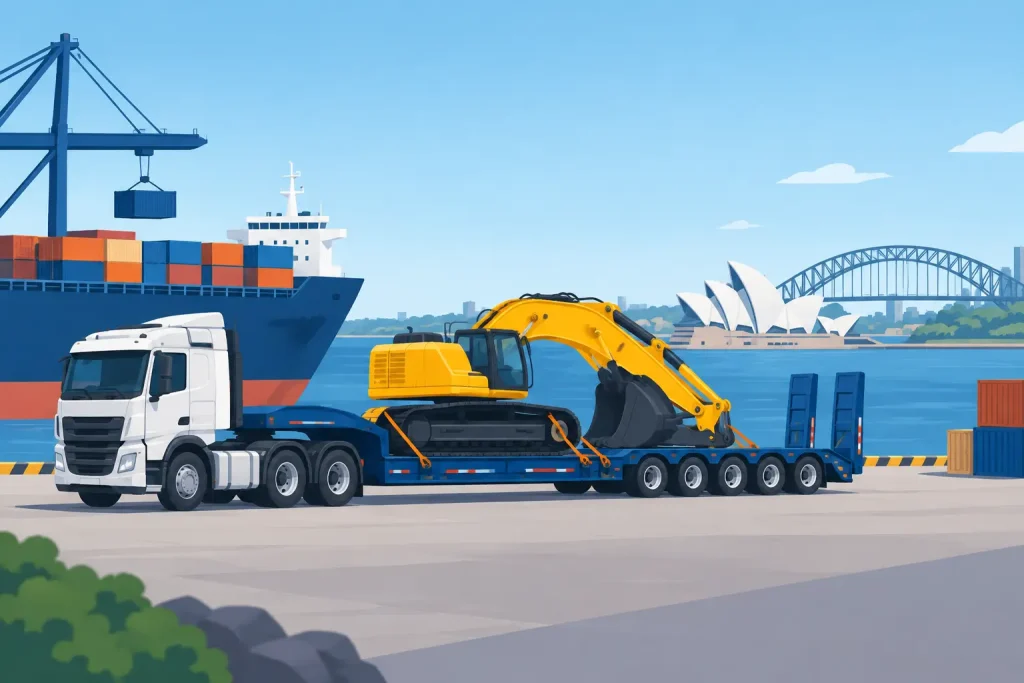
A heavy machine can be ready to leave an overseas supplier while its Australian delivery plan is still unresolved. That gap is where avoidable costs begin: terminal storage, missed delivery windows, unsuitable carriers, permit delays and equipment sitting idle on site. This heavy machinery shipping case study examines how a coordinated freight plan can reduce those risks for an Australian importer.
The scenario below is representative of the planning required for specialised machinery movements. Every shipment has its own dimensions, route constraints, compliance requirements and commercial priorities, but the operational lessons apply broadly to importers, manufacturers, contractors and project teams.
Heavy Machinery Shipping Case Study: The Shipment
An Australian civil construction business purchased a large tracked excavator and attachments from a supplier in East Asia. The equipment was required for a regional infrastructure project with a fixed mobilisation date. Delayed arrival would not simply inconvenience the business – it could affect subcontractor scheduling, plant availability and project costs.
The machinery was too large for a standard container. It required a breakbulk or roll-on/roll-off shipping assessment, specialised port handling and an oversized road transport solution after discharge. The cargo was bound for a Victorian port, then needed to move to a regional site with restricted road access.
At first glance, the task appeared straightforward: arrange sea freight, clear customs and deliver the excavator. In practice, the shipment involved several connected decisions. The freight method affected port handling. The arrival date affected permit timing. The machine’s dimensions and weight affected the carrier, escort requirements, route selection and unloading plan. A delay in any one area could place pressure on the entire movement.
The core operational risks
The first risk was incomplete cargo information. Machinery dimensions must include attachments, booms, counterweights and any components transported separately. A booking based on an incorrect overall width or height can result in unsuitable vessel space, incorrect transport pricing or a road movement that cannot be legally completed.
The second risk was customs and biosecurity clearance. Used machinery can attract close inspection because soil, plant material, grease and other contaminants may be present in tracks, undercarriages and engine bays. Cleaning at origin is generally faster and more cost-effective than arranging remedial work after the cargo reaches Australia.
The third risk was domestic delivery. Oversize transport is not a standard cartage job. It may require permits, route surveys, approved travel times, pilot vehicles, traffic management or coordination with site personnel. In regional areas, bridge limits, narrow access roads and overhead obstructions can change the preferred route.
Building the Freight Plan Before Collection
The most effective action in this case was to begin planning before the machinery moved from the supplier’s yard. Rather than treating the sea leg, customs process and final delivery as separate bookings, the shipment was managed as one end-to-end operation.
The importer provided the machinery make, model, serial number, commercial invoice, packing details, photographs and confirmed dimensions. The freight team then verified the total shipping profile, including weight distribution and lifting points where relevant. This information supported an assessment of the available shipping options and the likely handling requirements at both origin and destination.
A vessel service was selected based on more than the quoted freight rate. The decision considered sailing frequency, port pair, cargo acceptance requirements, transit time, discharge capability and the reliability of the onward delivery schedule. A cheaper option can be false economy if it arrives at a port that creates a more difficult or expensive road movement.
Customs and biosecurity preparation
The paperwork process began before the vessel departed. Commercial documents were reviewed for consistency, particularly the equipment description, country of origin, value and serial number. This reduced the chance of a customs entry being held up because the invoice, bill of lading and machinery identification did not align.
Biosecurity preparation was also addressed at origin. The supplier was instructed to thoroughly clean the machine, with particular attention to tracks, wheel wells, hydraulic areas, undercarriage cavities and attachments. Photographs taken after cleaning provided useful supporting records, although they did not replace inspection requirements on arrival.
For used equipment, the practical standard is simple: the machine should arrive in a condition that can be inspected without exposing Australian agriculture or the environment to contamination risk. If it does not, the importer may face cleaning directions, delays and additional charges. Early preparation offers far greater control than responding to a hold after discharge.
Planning the final kilometre
While the machinery was still at sea, the domestic transport plan was confirmed. The transporter assessed the dimensions, mass, loading configuration and destination access. The route was reviewed against applicable restrictions, and permit requirements were identified well before the cargo became available.
This phase also required direct communication with the delivery site. The site team needed to confirm access gate widths, ground conditions, unloading equipment, safe exclusion zones and a contact available at the planned delivery time. An oversize vehicle arriving at a site without suitable unloading arrangements can lose an entire delivery window.
The final delivery date remained subject to vessel arrival, discharge and clearance, but the planning work meant the parties had a controlled sequence rather than a last-minute scramble for a suitable float and permit.
Coordinating Arrival, Clearance and Delivery
When the vessel approached Australia, the focus shifted to status control. The importer needed clear updates on expected arrival, discharge timing, customs progress and likely delivery availability. Transparency matters because machinery importers often need to coordinate crews, site bookings and hired equipment around the movement.
After discharge, the equipment was processed through the required clearance steps. Because documentation had been prepared early and the machinery had been cleaned before export, the clearance process could proceed without the extended intervention that can occur when biosecurity concerns are identified.
Once release was confirmed, the domestic carrier collected the machinery in line with the approved transport arrangements. The movement took place during the permitted window, with delivery coordinated directly with the site representative. Attachments were managed as separate pieces where required, allowing the main machine and ancillary equipment to be unloaded safely and efficiently.
The result was not merely a machine delivered on time. The importer maintained greater control over project mobilisation, avoided unnecessary storage exposure and received a clearer view of costs across the international and domestic legs.
What This Case Shows for Australian Importers
The lesson from this heavy machinery shipping case study is that specialist freight is decided well before the vessel sails. The most expensive problems usually begin with missing information, delayed compliance checks or a domestic transport plan that starts only after the cargo arrives.
Importers should confirm machinery dimensions and weights from reliable source documents, including all removable and separately shipped components. They should also establish whether the cargo is new or used, how it has been cleaned, what documents are available and whether the destination can receive an oversize delivery.
Freight mode should be selected according to the machine’s profile and the overall supply chain, not just the ocean freight figure. Roll-on/roll-off services can suit self-propelled equipment, while breakbulk, flat rack or other arrangements may be more appropriate depending on dimensions, handling needs and shipping lanes. The right choice depends on vessel availability, cargo condition, origin capability and the final destination.
It is equally important to budget beyond the port. International freight is one part of the landed cost. Port handling, customs clearance, biosecurity requirements, storage risk, permits, escorts, specialised transport and site delivery all need to be considered before the equipment is purchased or shipped.
A Controlled Approach to Heavy Machinery Freight
For businesses moving high-value plant, freight coordination should support the commercial outcome: equipment arriving in the right condition, through the right compliance process, and at the site when operations need it. MCC World International can coordinate the sea freight, customs clearance, port handling and specialised road delivery required to bring those moving parts under one operational plan.
The earlier a machinery shipment is reviewed, the more options are available to manage cost, timing and risk. A complete cargo profile and a realistic delivery plan give importers the control needed to move from purchase order to project site with fewer surprises.