
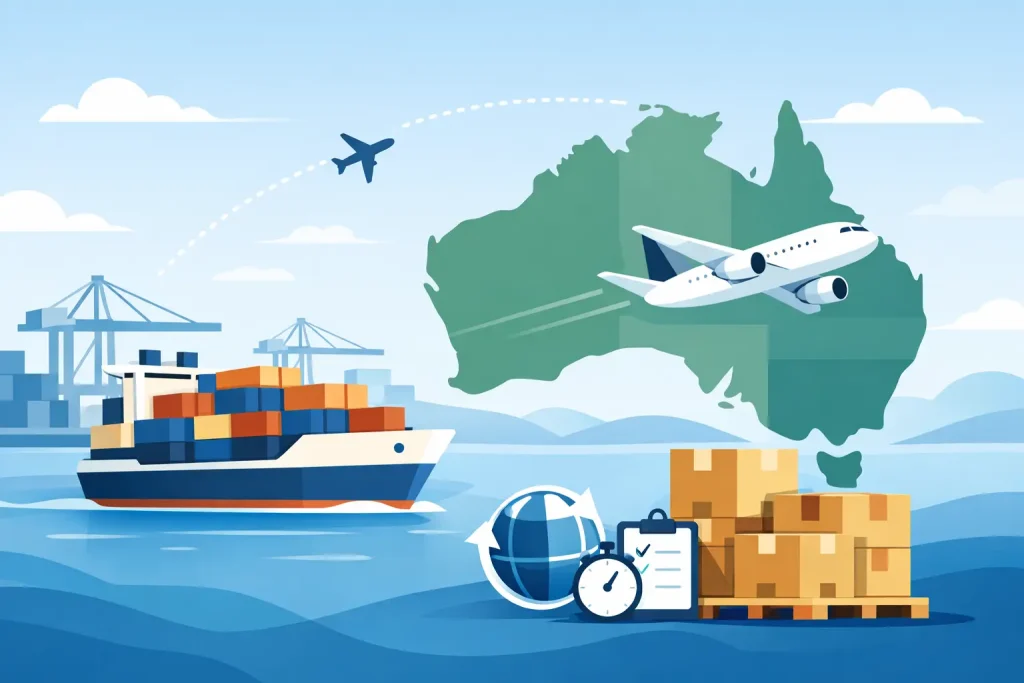
A shipment can leave its origin port on schedule and still lose weeks after it reaches Australia. The usual causes are not the vessel or aircraft. They are incomplete documents, incorrect tariff classifications, biosecurity issues, unpaid charges, or no clear plan for delivery after clearance. Knowing how to ship goods to Australia means managing the entire movement, from supplier collection through to delivery at your warehouse, site or customer.
For commercial importers, the most reliable approach is to make freight, customs, biosecurity and local transport part of one plan before cargo is packed. That gives your business clearer costs, fewer handovers and more control over delivery timing.
Start with the cargo, not the freight quote
Before choosing a transport mode, establish exactly what is being shipped. Freight rates and import requirements depend on the cargo’s dimensions, weight, value, origin, composition and intended use. A carton of garments, a container of tiles, a crated machine and a vehicle may all arrive through the same port, but their handling, documentation and compliance requirements differ considerably.
Confirm whether the goods are standard commercial cargo or require specialised handling. Heavy machinery, oversized equipment, project cargo, furniture, flooring, food-related goods, timber products, vehicles and goods with batteries can all need additional planning. Dangerous goods must be correctly declared, packed, labelled and documented before they can move by sea or air.
Ask suppliers for accurate packing details early. This should include the number of packages, gross weight, net weight, dimensions, packaging type, commodity description, country of origin and commercial value. A vague description such as “parts” or “samples” creates avoidable risk when customs authorities assess the shipment.
Choose sea freight or air freight based on the commercial need
Sea freight is generally the practical option for larger, heavier or less time-sensitive consignments. It is commonly used for full container loads, known as FCL, and smaller shipments consolidated with other cargo, known as LCL. FCL can provide better control and lower unit costs when volume is sufficient, while LCL allows businesses to import smaller quantities without paying for an entire container.
Air freight is suited to urgent, high-value or lightweight goods where speed outweighs the higher transport cost. It can reduce transit time substantially, but actual delivery timing still depends on export handling, airline capacity, customs clearance, biosecurity assessment and delivery availability in Australia.
The lowest freight rate is not automatically the best option. A slower service may be appropriate for replenishment stock with predictable demand, while an urgent production component may justify air freight to avoid a costly operational stoppage. Consider the total cost of a delayed shipment, not just the transport charge.
Understand the terms of sale before cargo moves
The agreed Incoterm determines which party is responsible for freight, insurance, export formalities, import charges and delivery at different points in the journey. Misunderstanding these terms is a common cause of unexpected costs and disputes between buyers and suppliers.
For example, goods supplied on an EXW basis may require the buyer to manage collection from the supplier’s premises and the export process. Under FOB, the supplier generally delivers cargo onboard the vessel at the export port, while the buyer takes responsibility from there. CIF may include sea freight and insurance to the destination port, but it does not usually mean that Australian customs clearance, terminal charges or local delivery are included.
Request a clear written breakdown of what is included in the supplier’s price and what will be payable in Australia. This allows you to compare freight options on a like-for-like basis and calculate your landed cost before committing to a purchase order.
Prepare customs documents accurately
Australian imports require correct commercial documentation. The documents needed vary by shipment, but a commercial importer will usually need the following:
- Commercial invoice showing the buyer, seller, goods description, value, currency and Incoterm.
- Packing list detailing package counts, weights, dimensions and marks.
- Bill of lading for sea freight or air waybill for air freight.
- Evidence of origin where a free trade agreement preference may apply.
- Import permits, licences or product certificates where the goods are regulated.
The commercial invoice must reflect the actual transaction. Understating value, using an incorrect origin, or providing an inaccurate description can lead to delays, reassessments, penalties or further examination. Customs classification is equally significant because it determines applicable duty rates, goods and services tax, and any concessional treatment.
A licensed customs broker can assess the tariff classification, prepare the import declaration and identify documentary requirements before arrival. For businesses importing regularly, this support also helps create a consistent compliance process across suppliers and product lines.
Treat biosecurity as a critical delivery milestone
Australia’s biosecurity controls are among the strictest in the world. The Department of Agriculture, Fisheries and Forestry may inspect or direct treatment for cargo that presents a biosecurity risk. Timber, plant-based products, food items, machinery, used equipment, animal-derived materials and contaminated packaging are common areas of scrutiny.
Packaging matters as much as the goods themselves. Timber packaging such as pallets, crates and dunnage must meet international treatment and marking requirements. Cargo should be clean and free from soil, plant material, insects, seeds and other contamination. Used machinery and vehicles require particular care because dirt, grass, oil residues and organic matter can trigger inspection or cleaning directions.
Do not assume a shipment will clear simply because a similar product was imported previously. Origin country, product composition, packaging and current biosecurity conditions can affect the assessment. Provide detailed product information early so permit needs and likely inspection requirements can be identified before the cargo departs.
Calculate the landed cost, not only the freight charge
The landed cost is the full cost of bringing goods to their Australian destination. It may include overseas collection, export documentation, freight, insurance, port or airport charges, customs clearance, duty, GST, biosecurity fees, inspections, storage, container handling, cartage and delivery.
Some costs arise only when cargo is delayed. Demurrage can apply when a container remains at the terminal beyond the free period. Detention may apply when shipping line equipment is returned late. Storage can accumulate quickly if documents, clearance instructions or delivery arrangements are not ready when cargo arrives.
A detailed pre-shipment estimate should show both the expected charges and the assumptions behind them. For example, an estimate may assume standard clearance, no inspection, delivery during normal hours and a site that can safely receive a container. Transparency at this stage allows procurement and operations teams to budget accurately and avoid surprises.
Plan the Australian delivery before the arrival notice
Getting freight to Melbourne, Sydney, Brisbane, Perth or another major gateway is only part of the task. Your delivery site must be suitable for the equipment and cargo being delivered. A full container may require a time slot, accessible loading area, clear entry point and appropriate unloading equipment. Heavy or awkward cargo may need a tail-lift truck, forklift, crane or specialised vehicle.
For LCL freight, cargo is generally unpacked at a depot before final delivery. For FCL freight, the decision may be whether to unpack at your premises or arrange a warehouse dehire and unpack service. The right choice depends on available space, labour, unloading capability and the urgency of returning the empty container.
Businesses with multiple stores, project sites or customers should also consider whether goods need to move directly to final destinations or first enter a warehouse for storage, order fulfilment and distribution. Integrating freight forwarding with warehousing and road transport can reduce handling gaps and improve stock visibility.
Build realistic timeframes into your purchasing plan
Transit time is only one part of the lead time. A reliable schedule also allows for supplier production, export booking, origin handling, vessel or flight movement, destination processing, customs and biosecurity clearance, and final cartage. Peak periods, port congestion, weather events, industrial action and equipment shortages can affect even well-planned shipments.
Keep suppliers accountable for cargo readiness dates, but avoid scheduling sales campaigns or production commitments against an optimistic arrival date. A buffer is particularly valuable for seasonal retail stock, construction materials and inputs that support manufacturing operations.
Regular shipment updates should report meaningful milestones, not just a departure date. Your operations team needs to know when cargo has been collected, loaded, departed, arrived, cleared and booked for delivery, along with any action required from the importer.
Use one coordinated freight process
Importing successfully is less about moving a box from A to B and more about controlling the decisions between those points. When sea or air freight, customs clearance, biosecurity coordination, port handling, warehousing and local delivery are managed separately, accountability can become fragmented.
MCC World International coordinates these stages as an end-to-end freight process, helping importers align transport choices with compliance requirements, delivery constraints and commercial deadlines. The objective is straightforward: cargo should arrive with the right documents, clear through the right channels and reach its final destination without unnecessary cost or disruption.
The best time to solve an import problem is before the supplier seals the cartons or loads the container. Bring your freight and customs requirements into the purchasing conversation early, and every shipment has a stronger foundation for a controlled arrival in Australia.