
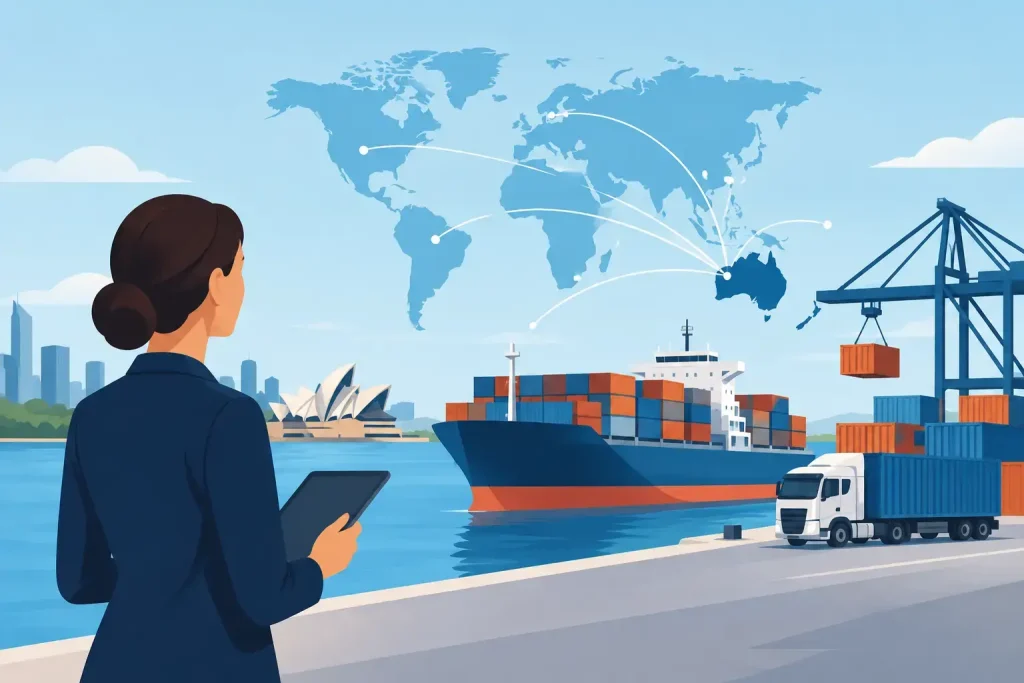
A container arriving at Port of Melbourne can be delayed, over budget or unexpectedly difficult long before it reaches the terminal. The cause is often not the freight rate. It is an Incoterm that was selected casually, a named delivery point that was too vague, or an assumption about who was responsible for import clearance. Understanding incoterms for Australian importers helps prevent those problems before a purchase order is issued.
Incoterms are standard international trade rules published by the International Chamber of Commerce. They define which party arranges and pays for defined parts of the transport journey, where risk transfers from seller to buyer, and who handles export and import formalities. The current rules are Incoterms 2020.
They are not a freight quote, a customs declaration or a substitute for a detailed sales contract. They do not determine when ownership transfers, how payment is made, or every insurance obligation. For Australian businesses, their value lies in making the operational handover clear across supplier, forwarder, carrier, customs broker and local delivery provider.
What Incoterms Actually Control
Every Incoterm needs two things: the three-letter rule and a precise named place or port. “FOB Shanghai, Incoterms 2020” gives a different outcome from “DAP 25 Example Road, Dandenong South VIC 3175, Incoterms 2020”. The named location is not a minor administrative detail. It determines the point at which cost, risk and practical control change hands.
Under some terms, the Australian buyer takes responsibility at the supplier’s factory. Under others, the seller remains responsible until goods reach an agreed Australian destination. The further the seller’s responsibility extends, the more their price may appear convenient. It can also leave the importer with less visibility of carrier selection, routing, local charges and shipment status.
A well-chosen rule should make four matters clear: who books the main carriage, who pays each transport leg, when risk passes, and who completes export and import clearance. If any of these points differs from the wording of the rule, record the variation in the sales contract rather than relying on emails or verbal assurances.
The Incoterms Most Relevant to Australian Importers
Not every Incoterm suits an import transaction. The right choice depends on the transport mode, supplier capability, cargo value and how much control the importer requires.
EXW can create avoidable export-side risk
EXW, or Ex Works, places the minimum obligation on the seller. The buyer collects goods from the seller’s premises and is generally responsible for loading, export clearance and the entire journey thereafter.
For an Australian importer buying from overseas, EXW often looks attractive because the supplier price is low. In practice, it can be difficult. A foreign buyer may not be able to complete export formalities in the country of origin, while the supplier may be better placed to load cargo safely and provide export documentation. If the supplier is loading a container or arranging export clearance, FCA is usually a more accurate and workable alternative.
FCA gives importers control without the EXW gap
FCA, or Free Carrier, is commonly suitable for containerised freight. The seller delivers cleared goods to a carrier or another nominated party at an agreed place. Risk transfers at that handover.
When the delivery point is the supplier’s premises, specify who loads the vehicle or container. When it is a freight terminal or consolidation depot, identify the facility precisely. FCA allows an Australian importer to nominate the freight forwarder and control the international movement while ensuring the supplier manages export clearance in their own market.
FOB, CFR and CIF are for sea freight, not every shipment
FOB, CFR and CIF are often used by habit, particularly in Asian supply chains. They are designed for conventional sea or inland waterway shipments where goods are delivered on board the vessel. They are not generally the best fit for containerised cargo handed to a carrier at a terminal before vessel loading.
Under FOB, the buyer arranges and pays the ocean freight once goods are on board. Under CFR, the seller pays the freight to the destination port but risk still transfers once the goods are on board at origin. CIF is similar, except the seller also arranges minimum cargo insurance.
The distinction between freight cost and risk is critical. A supplier paying freight under CFR or CIF does not mean they carry the transit risk all the way to Australia. Importers should also check insurance limits and claims procedures rather than assuming CIF cover is sufficient for high-value stock, machinery or project cargo.
CPT and CIP suit multi-leg or containerised movements
CPT and CIP can be used with any transport mode. The seller arranges carriage to the named destination, but risk transfers when the goods are handed to the first carrier. Under CIP, the seller also arranges insurance at a higher minimum level than CIF.
These terms can be useful where a supplier has favourable freight arrangements but the buyer understands that risk transfers early in the journey. They require close attention to the named destination and the exact scope of the seller’s freight booking.
DAP, DPU and DDP shift more work to the seller
DAP means Delivered at Place. The seller delivers goods, ready for unloading, at the agreed Australian location. The buyer handles unloading, import clearance, duty, GST and other border charges.
DPU means Delivered at Place Unloaded. The seller delivers and unloads at the named location, but the buyer generally remains responsible for import clearance. It may suit specialised equipment where unloading is part of the supplier’s scope, but it needs careful planning around site access, lifting requirements and safety responsibilities.
DDP, or Delivered Duty Paid, places the greatest obligation on the seller, including import clearance and payment of duties and taxes. It can appear simple to the buyer, but it is not always appropriate for Australian imports. The overseas seller must be able to meet Australian customs, biosecurity and tax requirements correctly. If declarations are inaccurate or goods require permits, the Australian business can still face disruption, scrutiny and commercial consequences. DDP should only be used where the seller’s Australian compliance arrangements are proven and transparent.
Australian Customs and Biosecurity Do Not Disappear
An Incoterm allocates contractual tasks between buyer and seller. It does not remove Australia’s border requirements. Imported goods may require correct tariff classification, customs valuation, country-of-origin evidence, import permits, treatment certificates or biosecurity direction.
Australian importers should confirm who is listed as importer of record, who provides commercial invoices and packing lists, and who is responsible for supplying product information required for customs clearance. This is particularly relevant for timber products, food, machinery, textiles, vehicles and goods with packaging that may attract biosecurity attention.
Duty, import processing charges, GST and terminal-related charges should also be considered as part of landed cost. A low supplier price can lose its advantage quickly if origin charges, destination handling, storage, inspections or delivery requirements were not identified before shipment.
How to Select the Right Incoterm Before You Buy
The best Incoterm is rarely the one your supplier uses for every customer. It should reflect your supply chain capability and the shipment’s actual risks. Before confirming the purchase order, establish the following:
- the transport mode and whether the cargo is containerised, breakbulk, air freight or a multimodal movement;
- the exact named place, including terminal, port, depot or delivery address;
- who controls the freight booking and receives shipment milestones;
- which party arranges cargo insurance and what the policy covers; and
- who is accountable for export documentation, Australian customs clearance, biosecurity requirements and final delivery.
For regular import programmes, consistency matters. Using the same suitable terms across suppliers can improve cost comparisons, reduce instruction errors and make freight planning more predictable. That does not mean every shipment needs the same rule. Urgent air freight, oversized machinery and full container retail freight can each require a different allocation of responsibility.
Turn the Incoterm Into Clear Freight Instructions
Once the term is agreed, provide your freight partner with the supplier details, cargo description, dimensions, weights, ready date, commercial terms and named place. Ask for the quote to separate international freight, origin charges, destination charges, customs clearance and local cartage where possible. This creates visibility well before the cargo arrives.
It is also sensible to confirm the Incoterm appears consistently on the purchase order, commercial invoice, packing list and freight instructions. Conflicting documents create delays at the point when goods need to move, and can make it harder to identify who authorised a cost or accepted a risk.
MCC World International can help businesses assess the practical effect of their selected trade terms across freight, customs clearance and final delivery. The objective is not simply to move cargo, but to establish a controlled import process that supports reliable supply chain performance.
The most useful Incoterm is the one both parties can genuinely perform. Agree it early, name the place precisely, and ensure the freight and compliance plan matches the contract before the goods leave the supplier’s control.