
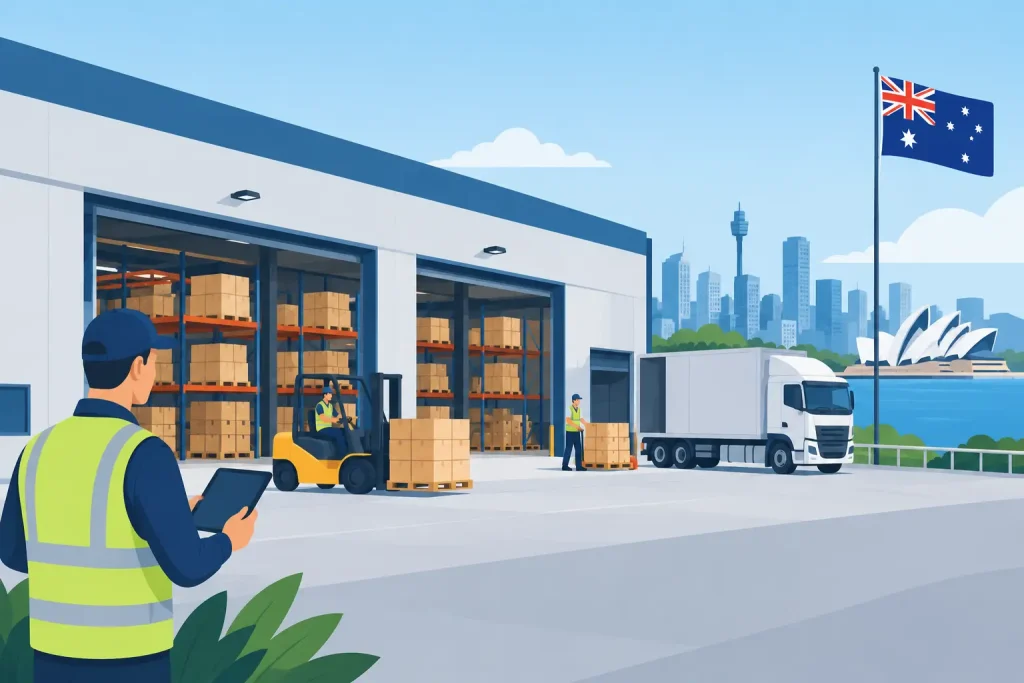
A warehouse can be full and still fail to support the business. Stock may be difficult to locate, orders may miss cut-off times, and freight may leave without the paperwork or delivery instructions needed to reach the customer. This warehouse and distribution guide sets out how Australian businesses can turn storage and delivery into a controlled part of their supply chain, rather than a daily source of cost and disruption.
For importers, wholesalers, retailers and manufacturers, the objective is not simply to hold inventory. It is to receive goods accurately, protect them, make them available when required, and distribute them through the most suitable freight network. The right operating model depends on product type, order profile, customer locations and the level of service your market expects.
Start With the Flow of Goods, Not the Building
Warehouse decisions are often made around available space or a quoted pallet rate. Those factors matter, but the first question should be how goods move through the operation. Map the journey from arrival at port, airport or supplier through to final delivery, including every handover, document and decision point.
For imported cargo, this may begin with customs clearance and collection from a wharf, depot or airport. Goods then move to the warehouse for receipting, put-away, storage, picking, packing and dispatch. A weak handover between any of these stages can create avoidable costs, particularly where demurrage, storage charges, redelivery or missed delivery windows are involved.
A practical warehouse operation should have clear answers to several commercial questions. How quickly must containers be unpacked? Are goods sold by pallet, carton, metre, unit or bundle? Do customers require labels, barcodes, appointment bookings or proof of delivery? Are orders primarily metro, regional or interstate? The answers determine the layout, labour model, systems and transport capability required.
Receiving Accuracy Protects the Entire Supply Chain
The receiving dock is where stock records either become reliable or begin to drift. Goods should be checked against purchase orders, packing lists and delivery documentation before they are accepted into available inventory. Carton counts, pallet quantities, visible damage, lot numbers and expiry dates should be recorded where relevant to the product.
This is particularly important for furniture, flooring, tiles, textiles and retail freight, where product variations can be similar but commercially distinct. A short receipt, damaged carton or incorrect item code may not be discovered until an urgent customer order cannot be completed.
A sound process separates quarantined or damaged stock from saleable stock and documents discrepancies promptly. Where imported goods arrive in containers, unloading should also be planned around container return times, labour availability and safe handling requirements. The cheapest unpacking option can become expensive if it leads to detention, product damage or poor inventory visibility.
Put-away should support picking, not just storage
Putting stock in the nearest available location may save minutes at receipting but add hours to picking over the following months. Fast-moving lines should be accessible from efficient pick faces, while reserve stock can sit in higher or less accessible locations. Heavy, fragile, oversized or awkward items need locations and equipment suited to their handling requirements.
The approach depends on demand. Businesses with a small range of high-volume products benefit from a different layout than those managing thousands of slow-moving SKUs. Seasonal stock also needs a plan before peak periods arrive, not when warehouse aisles are already congested.
Inventory Control Must Match Commercial Reality
Stock on hand is only useful if it is available to sell and can be found quickly. A warehouse management system, or a disciplined inventory platform with appropriate scanning processes, gives operations teams visibility across receipts, locations, allocations, orders and dispatches. However, a system cannot correct poor master data or inconsistent warehouse practices.
Product dimensions, weights, carton configurations and pallet quantities should be maintained accurately. These details affect storage density, freight pricing, vehicle selection and safe handling. They are also essential when quoting customers or planning delivery runs, particularly for bulky items and project cargo.
Cycle counts are generally more effective than waiting for an annual stocktake to reveal problems. Counting high-value or fast-moving lines more often helps identify recurring issues such as mis-picks, unrecorded damage or incorrect units of measure. The goal is not perfect reporting for its own sake. It is dependable fulfilment, fewer credit claims and better purchasing decisions.
Build Fulfilment Around the Customer Promise
Distribution performance is measured by what the customer receives, when they receive it and in what condition. A warehouse may pick orders quickly but still provide poor service if dispatch cut-offs are unclear, carrier collections are inconsistent or delivery instructions are missing.
Set service standards that reflect the business model. For example, metro orders received before a defined time may dispatch the same day, while regional and interstate orders may follow scheduled linehaul departures. Some customers will require timed deliveries, tail-lift vehicles, site bookings or delivery to a commercial dock. Others may need residential delivery, careful handling or two-person delivery for larger items.
Picking and packing controls should be proportionate to the cost of error. Barcode verification is valuable where SKU volumes are high. For fragile, high-value or made-to-order goods, a final visual check and photographs at dispatch may provide stronger protection. The right level of control depends on claim exposure, product complexity and customer expectations.
Choose Transport by Freight Profile, Not Habit
A distribution plan should not rely on one carrier or one service type for every order. Parcel networks, pallet freight, dedicated vehicles, road linehaul and specialised carriers each have a place. The most suitable option depends on weight, dimensions, destination, urgency, access conditions and the value of the consignment.
Metro freight can be sensitive to delivery windows, congestion and receiver availability. Regional Australia introduces longer lead times and fewer service frequencies. Interstate movements require careful planning around linehaul schedules, cross-dock points and the risk of an order missing a departure. For oversized machinery, vehicles or project cargo, transport planning may also involve permits, route assessments, lifting equipment and specialised restraints.
Freight cost should be assessed alongside service performance. A low linehaul rate may not represent value if it creates repeated damages, failed deliveries or lengthy claim resolution. Reporting should track on-time dispatch, on-time delivery, damage rates, delivery exceptions and freight spend by customer, lane and product category.
Compliance and Safety Are Operational Controls
Warehousing and distribution carry legal and commercial obligations that cannot be treated as paperwork after the fact. Businesses need appropriate processes for chain of responsibility, load restraint, dangerous goods where applicable, workplace safety and transport documentation. Imported goods may also require records that support customs, biosecurity or product compliance obligations.
Warehouse safety has a direct impact on continuity. Clearly separated pedestrian and forklift zones, suitable racking inspections, trained operators and safe manual-handling procedures reduce the likelihood of injuries and stock damage. These controls are especially important in busy facilities where container unloading, pallet movements and outbound dispatch occur at the same time.
Security also deserves practical attention. Controlled access, stock movement records, dispatch checks and clear responsibility for high-value goods help reduce loss and make investigations faster when an issue occurs.
Know When a 3PL Model Makes Sense
Operating your own warehouse offers direct control, but it requires space, systems, people, equipment and management capacity. A third-party logistics model can provide access to established warehousing and distribution infrastructure without carrying all of those fixed costs internally.
The trade-off is that the provider must understand your products, service standards and growth plans. A suitable 3PL partner should be able to explain how it manages inventory accuracy, order cut-offs, freight exceptions, reporting, claims and peak-volume periods. It should also coordinate effectively with inbound freight and customs processes, rather than treating warehousing as an isolated service.
For businesses importing into Australia, integrated management can reduce handovers between customs clearance, container transport, unpacking, storage and domestic distribution. MCC World International supports this type of end-to-end coordination, helping businesses maintain visibility from international freight arrival through to final delivery.
Keep Reviewing the Pressure Points
Warehouse and distribution requirements change as product ranges, sales channels and customer locations change. Review operating data regularly, especially after a peak period, a new customer launch or a change in import volumes. Look for recurring exceptions rather than isolated mistakes: late receipts, frequent stock adjustments, missed dispatches, damaged items or high-cost delivery lanes.
The strongest operation is not necessarily the largest facility or the lowest freight rate. It is the one that gives your business accurate stock, predictable order fulfilment and enough flexibility to keep serving customers when conditions change.