
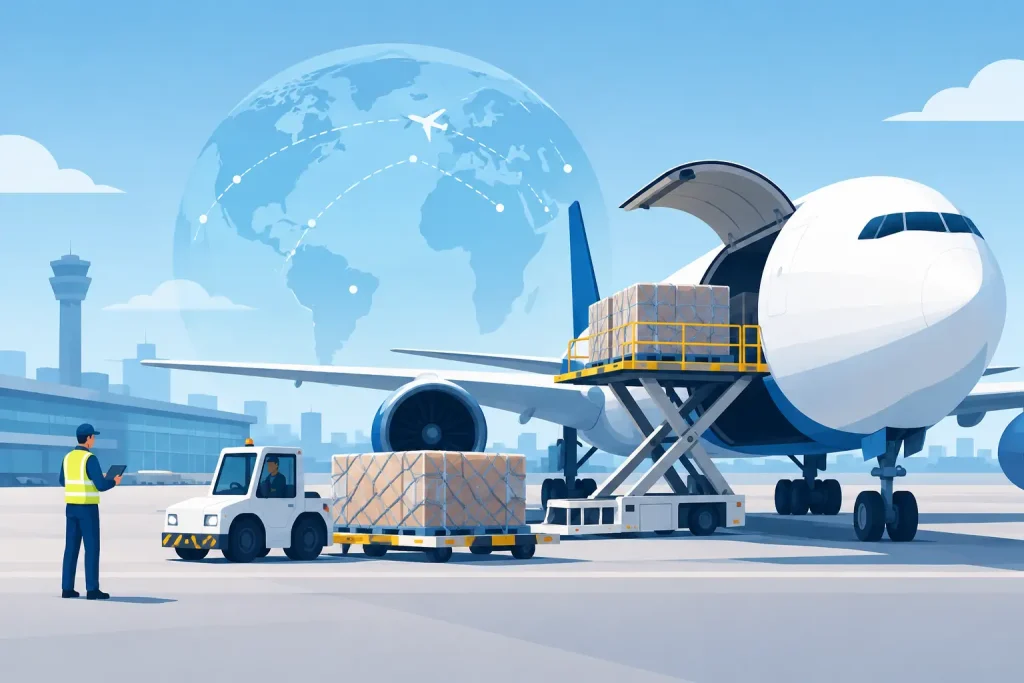
A production line waiting on a small replacement component can lose far more in downtime than the cost difference between air and sea freight. That is the practical question behind “when should businesses use air freight?” It is not simply the fastest transport option. It is a strategic choice for shipments where speed, certainty, cargo value or supply chain continuity outweigh the higher freight cost.
For Australian importers and exporters, air freight can shorten international transit from weeks to days. However, it also comes with capacity constraints, stricter cargo acceptance rules and pricing based on chargeable weight. The right decision depends on the commercial impact of delay, not just the quoted freight rate.
When Should Businesses Use Air Freight?
Businesses should consider air freight when a delayed shipment would create a greater cost or risk than the premium paid for faster transport. This often applies to urgent replenishment stock, time-sensitive components, high-value products and cargo supporting a fixed launch, event or project deadline.
Air freight is particularly useful when inventory levels are low and an ocean shipment will not arrive in time. Rather than holding excessive safety stock year-round, some businesses use sea freight for planned volume and air freight selectively to resolve short-term supply gaps. Used carefully, this approach can protect service levels without making air freight the default for every consignment.
It can also be the sensible option for new suppliers, product trials and smaller initial orders. A business may choose to move a limited quantity by air while confirming product quality, demand and customs documentation before committing to a larger sea freight programme.
The cost of delay is higher than the freight cost
The strongest case for air freight is usually financial rather than logistical. Consider a retailer facing an imminent promotional period, a manufacturer whose production line needs a specific part, or a construction project awaiting critical equipment. In each case, the direct air freight cost may be significant, but the cost of missed sales, idle labour, contractual penalties or damaged customer relationships can be substantially higher.
This assessment should include more than lost revenue. Delays can create expedited local transport costs, warehouse disruption, rescheduling fees and pressure on customer service teams. They may also cause a business to lose a seasonal sales window that cannot be recovered once the goods arrive.
The goods are high value, compact or sensitive
Air freight generally makes more commercial sense for smaller, higher-value shipments than for bulky, low-margin cargo. Electronics, medical devices, fashion samples, urgent spare parts, precision equipment and selected automotive components are common examples.
A product’s physical size matters as much as its actual weight. Airlines charge on whichever is greater: the actual weight or volumetric weight. A lightweight but oversized carton can therefore attract a much higher charge than expected. Before selecting air freight, businesses should confirm accurate packed dimensions, gross weight and the airline’s applicable volumetric calculation.
High-value cargo also requires disciplined handling. Secure packaging, accurate commercial documents, declared values and appropriate cargo insurance are essential. Faster transit reduces the time goods spend in the supply chain, but it does not remove the need for sound risk management.
A fixed deadline cannot move
Some deadlines are operationally immovable. These include trade shows, retail launch dates, aircraft or vessel repair schedules, product recalls, medical supply requirements and project milestones. Air freight gives businesses the best chance of meeting these commitments, particularly when cargo is ready to move and documentation is complete.
That said, an airline schedule is not a guarantee of delivery. Capacity can be affected by weather, security requirements, airport congestion, handling delays and changes to flight operations. A reliable freight plan accounts for collection, export clearance, airline cut-off times, transit connections, import clearance and final delivery, rather than measuring only the flight time.
When Air Freight Is Not the Best Option
Air freight is not automatically the right answer when goods are large, heavy, low value or not time-critical. Sea freight will usually provide a more cost-effective solution for containerised stock, regular replenishment orders, furniture, tiles, flooring, machinery and other high-cube cargo with predictable lead times.
It may also be unsuitable if the cargo is restricted, poorly packaged or not ready for clearance. Dangerous goods can travel by air, but only when correctly classified, packed, labelled and documented under applicable air transport requirements. Some commodities are prohibited or subject to airline-specific restrictions. Attempting to rush unprepared cargo can result in rejection, storage charges and avoidable delays.
For many businesses, the most efficient model is not air versus sea. It is a planned combination of both. Core inventory can move by sea on a forecast basis, while a carefully controlled air freight allocation protects against supplier delays, unexpected demand or urgent stock shortages.
Build the Decision Around Total Landed Cost
A freight quote alone does not show the full cost of using air freight. Businesses should compare total landed cost and the operational consequences of each transport mode. This includes origin collection, export handling, security screening, airline charges, customs brokerage, duty and GST where applicable, terminal fees, quarantine requirements, delivery and insurance.
Transit time should also be measured door to door. An airport-to-airport service may look fast, but cargo can still be delayed if it waits for collection at origin, misses a flight cut-off, requires additional documents or is held for Australian Border Force or biosecurity assessment on arrival.
For imported goods, accurate tariff classification, declared value and origin information help prevent clearance issues. Businesses importing timber products, food-related goods, plant-based materials or other biosecurity-sensitive items should confirm requirements well before cargo departs. Speed in transport cannot overcome a compliance problem at the border.
A Practical Air Freight Decision Check
Before booking, operations and procurement teams should be able to answer four questions:
- What is the measurable cost if the goods arrive late?
- Is the cargo value, size and weight commercially suitable for air freight?
- Are the goods packed, labelled and documented for airline acceptance and Australian clearance?
- Can the shipment be delivered to the final destination within the required timeframe, not merely flown to an airport?
If the answer to the first question is significant and the remaining three are clear, air freight is likely worth considering. If the deadline is flexible or the cargo is bulky and low value, sea freight, road freight or a consolidated service may deliver better value.
Planning Air Freight for Reliable Results
The best air freight movements are planned early, even where the shipment is urgent. Providing a freight forwarder with commodity details, carton dimensions, weight, origin address, consignee details, ready date and required delivery date allows realistic routing and pricing to be assessed.
It is also helpful to identify whether the shipment can be split. Sending the most urgent portion by air and the balance by sea often reduces total logistics cost while keeping operations moving. For example, a retailer may air freight enough stock to cover immediate demand, then receive the main order by sea freight once it arrives.
Packaging deserves close attention. Cartons need to withstand multiple handling points, protect the cargo and make efficient use of available space. Clear marks and labels, correct consignee information and accessible documentation reduce the chance of cargo being misrouted or held at a terminal.
A capable freight partner should coordinate the movement beyond the airport, including collection, customs clearance, biosecurity processes where required, local cartage and delivery. This end-to-end visibility is especially valuable for businesses managing multiple suppliers, varied product lines or deliveries across Australian states.
MCC World International helps businesses assess the appropriate freight mode against urgency, cost, compliance and final delivery requirements, rather than treating every fast shipment as an air freight job.
Air freight delivers its greatest value when it protects a business decision that cannot wait. By measuring the cost of delay, confirming cargo suitability and planning the full door-to-door movement, businesses can use it as a controlled supply chain tool rather than an expensive last-minute reaction.