
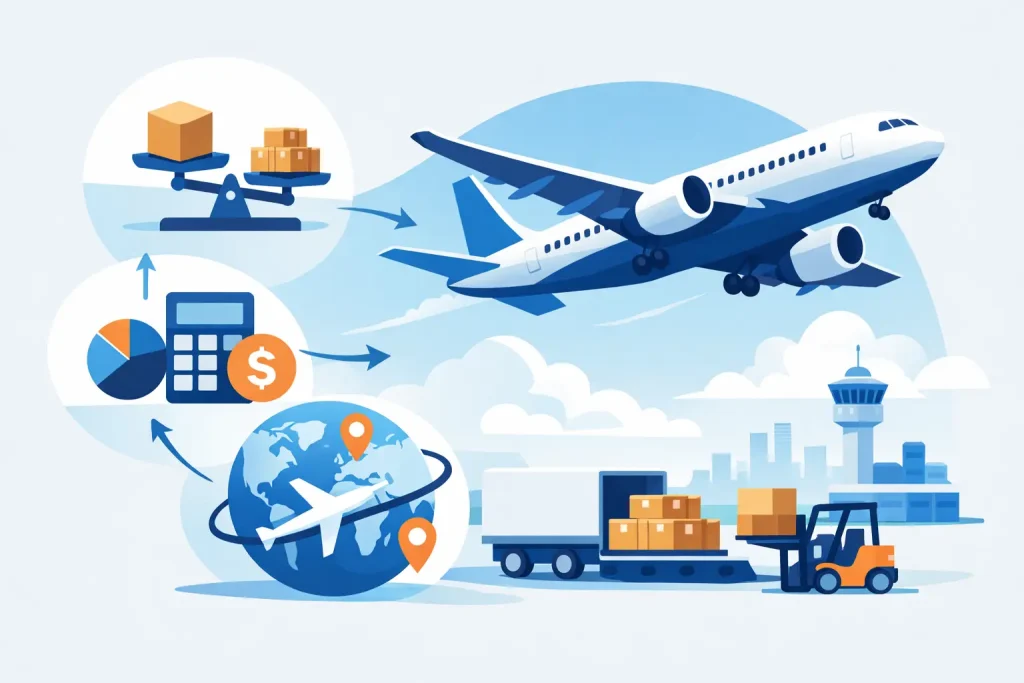
A shipment can be urgently needed and still be the wrong candidate for air transport. Air freight costs are driven by more than a quoted rate per kilogram: dimensions, routing, airline capacity, dangerous goods requirements, terminal charges and delivery arrangements all affect the final landed cost. For Australian importers and exporters, understanding those moving parts makes it easier to protect margins without compromising supply continuity.
What makes up air freight costs?
Air freight pricing starts with the shipment’s chargeable weight. Airlines charge on whichever is higher: the actual gross weight or the volumetric weight. This reflects a practical constraint of aircraft operations. A large carton of lightweight goods may take up more valuable aircraft space than a smaller, heavier consignment.
For most international air freight, volumetric weight is calculated by multiplying length, width and height in centimetres, then dividing by 6,000. A shipment measuring 120 cm x 100 cm x 80 cm has a volume of 960,000 cubic centimetres. Divided by 6,000, it is charged as 160 kg, even if its physical weight is only 95 kg.
The airline freight rate is only one part of the transport cost. A complete quotation may also include origin collection, export handling, security screening, terminal charges, airline fuel and security surcharges, customs clearance, import processing, quarantine inspections where required, cargo terminal fees and final delivery. The exact items depend on the origin, destination, cargo type and agreed service scope.
This is why comparing two figures labelled as an air freight rate can be misleading. One may cover airport-to-airport movement only, while another includes collection, customs brokerage and delivery to a Melbourne, Sydney, Brisbane or regional site. The better comparison is the total cost to move the shipment from its starting point to the required delivery point, with every exclusion clearly identified.
The factors that change air freight costs most
Chargeable weight and packaging dimensions
Weight is fundamental, but packaging design often has the biggest controllable effect. Oversized cartons, unnecessary void space and pallets built higher than necessary can increase volumetric weight quickly. This is particularly relevant for textiles, retail goods, automotive parts and light manufactured products.
Consolidating cartons can reduce handling and documentation costs, but it does not always reduce the freight charge. Combining several cartons into a larger skid may increase its dimensions enough to create a higher volumetric weight. The right choice depends on the goods, packing density, handling needs and airport acceptance requirements.
Route, capacity and transit time
Not all air freight services are priced alike. A direct service will usually carry a premium over a routing with one or more transhipment points. Similarly, an express option can cost materially more than a deferred or consolidated service.
Capacity changes throughout the year. Rates commonly rise before Christmas, around major retail promotions, during peak production periods in Asia and when sea freight disruption pushes more cargo into the air market. Passenger aircraft also carry freight in their lower holds, so changes to passenger schedules can affect available capacity on certain lanes.
For a business replenishing stock, the key question is not simply whether a faster service is available. It is whether the value of earlier arrival exceeds the additional freight cost. Avoiding a stock-out, protecting a production line or meeting a contracted delivery date may justify premium air freight. Moving slow-selling inventory by air usually does not.
Cargo type and handling requirements
General cargo is generally simpler to quote and move than shipments requiring specialist handling. Dangerous goods, lithium batteries, temperature-sensitive products, high-value items, oversized pieces and cargo with unusual loading requirements can attract extra charges and require more lead time.
Dangerous goods must be correctly classified, packed, marked, labelled and documented before airline acceptance. An incorrectly prepared consignment may be rejected at the terminal, creating storage, rehandling and rebooking costs. Early review is far less costly than solving a compliance issue after the cargo has reached the airport.
Origin and destination charges
Collection from a remote supplier, delivery to a site with restricted access, tail-lift requirements, timed bookings and after-hours receiving can all change the transport component of an air shipment. Airport terminals also apply charges for receiving, processing and releasing cargo.
For imports into Australia, final delivery should be planned as part of the original booking. A low airport-to-airport rate may lose its value if cargo waits at the terminal while delivery details, customs documentation or quarantine requirements are being resolved.
Customs, biosecurity and the landed cost
Air freight does not remove the need for customs and biosecurity compliance. Imported goods may be subject to duty, Goods and Services Tax, import processing charges and other government requirements. The applicable duty rate depends on the tariff classification, country of origin, product description and any relevant free trade agreement.
Biosecurity is equally significant for cargo entering Australia. Timber packaging, food-related products, plant materials, machinery, used goods and items exposed to soil or organic contamination may require inspection, treatment or supporting documentation. These requirements are not simply administrative. Delays at this stage can lead to storage charges and disrupt planned delivery schedules.
Accurate commercial invoices, packing lists, product descriptions, tariff information and evidence of origin help customs clearance proceed efficiently. Descriptions such as “parts” or “samples” are often too vague for a reliable assessment. A clear description should identify what the goods are, what they are made from and their intended use.
When budgeting, separate the freight charge from the landed cost. A freight quotation may be competitive while the full landed cost is higher than expected because duty, GST, clearance activity, inspection or domestic delivery has not been allowed for. Procurement teams make stronger decisions when these costs are viewed together rather than in separate departmental budgets.
How to reduce air freight costs without creating risk
Cost control works best when it begins before a purchase order is released. Once goods are packed and a factory is facing a deadline, the available options narrow and premium services become more likely.
First, use air freight selectively. Split shipments can be effective: send the stock needed immediately by air and move the balance by sea freight. This approach can maintain availability while avoiding the cost of flying an entire order.
Second, improve packing specifications with suppliers. Ask for carton dimensions and gross weights before collection, particularly where goods are light but bulky. Set practical carton size limits, reduce excess packaging where product protection allows, and ensure pallets are built to the lowest safe height.
Third, provide forward visibility. A forecast of expected shipments, even if it is not final, gives a freight forwarder more opportunity to plan capacity and recommend consolidation or alternative departure dates. Last-minute bookings tend to be more exposed to higher rates and limited airline options.
Fourth, match the service level to the commercial requirement. Express air freight is appropriate when every day has measurable value. Consolidated or deferred air freight may be suitable where the delivery window has flexibility. The cheapest option is not automatically the best option if it exposes the business to missed delivery commitments or terminal storage.
Finally, standardise shipment data. Consistent product descriptions, accurate weights, dimensions, commodity details and receiver instructions reduce rework. They also produce more reliable quotations, because the pricing is based on the cargo that will actually be tendered to the airline.
Questions to ask before accepting an air freight quote
A useful quotation should make the movement clear from collection through to delivery. Before approving a booking, confirm whether pricing is based on actual or volumetric weight, which surcharges are included, the estimated transit time, the airline or service type, and whether the cargo will move direct or via transhipment.
Also confirm who is responsible for export clearance, Australian customs clearance, biosecurity coordination, duty and GST payment, terminal charges and final-mile delivery. If the shipment is urgent, ask what happens if it misses the planned flight and whether an alternative service can be arranged.
For regular trade lanes, comparing total landed cost and service performance over several shipments is more valuable than selecting a provider solely on a single rate. Reliability, communication and correct documentation often prevent expenses that are not visible in an initial quote.
Planning air freight as part of the supply chain
Air freight is most effective when it is treated as a strategic supply chain tool rather than an emergency response. It can support product launches, urgent spare parts, seasonal replenishment, high-value goods and recovery from supplier delays. It can also become an expensive habit when inventory forecasting, supplier lead times or order planning are not controlled.
MCC World International helps businesses assess the practical trade-offs across air, sea, road and warehousing requirements, with attention to customs compliance and final delivery outcomes. The objective is not to put every shipment on the fastest service. It is to move the right cargo, on the right mode, with costs and responsibilities understood before the goods leave the supplier.
The most useful next step is to review your last few urgent air shipments. Identify whether the urgency came from genuine customer demand, an unavoidable disruption or a preventable planning gap. That distinction will show where air freight delivers real commercial value and where a better logistics plan can reduce spend.