
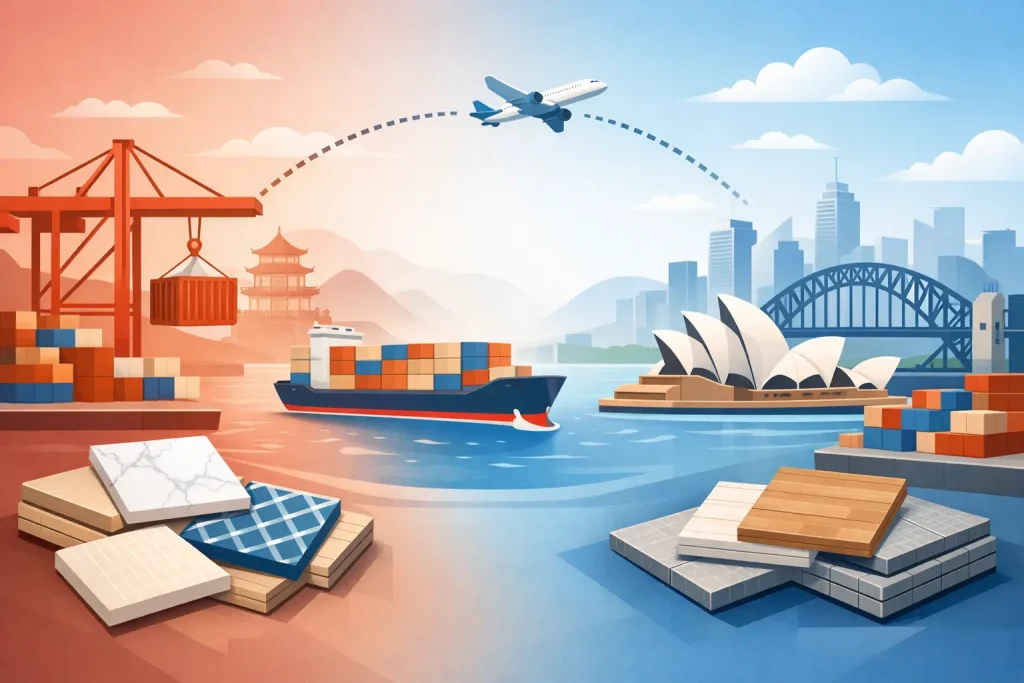
A tile shipment can look commercially attractive on a supplier quotation and become expensive once weight limits, breakage risk, port charges and local delivery are considered. For businesses importing tiles from China to Australia, the result depends on planning the entire movement – from product verification at the factory to delivery at the warehouse or project site.
Tiles are dense, fragile and often required in substantial volumes. They demand more than a standard freight booking. A sound import plan protects product quality, manages compliance exposure and gives procurement teams a realistic landed cost before purchase orders are released.
Start with the product, not the freight rate
Before confirming a supplier, establish exactly what is being purchased. Product descriptions such as porcelain tile, ceramic wall tile or natural stone-look tile are not sufficient on their own. Confirm the tile dimensions, thickness, finish, square metres per carton, cartons per pallet, gross weight, country of manufacture and total shipment weight.
Request physical samples and compare them against the approved specification. Colour variation, calibre consistency, glazing quality, edge finish and slip performance can materially affect whether a tile is suitable for its intended use. This is particularly relevant for commercial flooring, wet areas, hospitality projects and external applications.
Australian building projects may require evidence that a selected tile is suitable for the relevant use and installation method. Depending on the product and project, buyers may need information on slip resistance, water absorption, breaking strength, chemical resistance or other performance characteristics. Standards and project specifications should be reviewed early, rather than after the cargo has arrived.
The supplier should provide a clear product specification, packing list and test information that correspond to the exact production batch. If a builder, architect or retailer requires a particular standard, make that requirement part of the purchase order. A generic test report for a similar tile is not always enough.
Choose a supplier and control quality at origin
The lowest factory price is rarely the safest buying decision. Tile factories and trading companies can both be effective suppliers, but businesses should understand who controls production, packing and export documentation. Verify the supplier’s business registration, export experience and ability to produce consistent quantities over time.
A pre-shipment inspection is often worthwhile for commercial orders. An inspection can check carton markings, quantities, pallet condition, visible damage, shade and calibre references, packaging strength and whether the goods match the approved sample. It also provides an opportunity to identify problems before the container is sealed.
Packaging deserves close attention. Tiles should be packed in strong cartons, with clear batch identification and sufficient internal protection. Pallets need to be suitable for container movement and, where timber packaging is used, compliant with international treatment and marking requirements. Poor packaging can turn a minor container movement into a costly claims issue.
It is also prudent to address asbestos risk before shipment. Australia prohibits the importation of asbestos and goods containing asbestos. While ceramic and porcelain tiles are not automatically a concern, importers should obtain credible product composition evidence where required and retain it with their import records. Australian Border Force may seek supporting documentation or testing evidence for goods considered at risk.
Plan the shipping method around weight and handling
Most tile imports move by sea freight. The choice between a full container load and less than container load freight should be based on total volume, weight, handling sensitivity and delivery requirements – not simply the cubic measurement.
A 20-foot container is commonly used for tiles because the cargo reaches weight limits well before it fills the container. A 40-foot container may suit larger orders, but its payload, road transport limits and unloading requirements need to be assessed carefully. Overweight containers can create delays, additional handling and transport restrictions in Australia.
Less than container load freight can suit trial orders or mixed product ranges. However, it involves consolidation, deconsolidation and more handling points. That increases the chance of carton damage, particularly for heavy and brittle cargo. For a regular tile programme with sufficient volume, a full container can provide better cargo control and a more predictable cost per square metre.
Shipping terms also determine where responsibility sits. Under EXW terms, the buyer takes on collection from the factory and export arrangements. FOB terms can be more practical when the supplier is responsible for delivering cleared cargo to the nominated port. The correct Incoterm depends on the supplier’s capability and the importer’s appetite for origin control, but it must be agreed precisely. Vague terms lead to unexpected origin charges and disputes over who was responsible for missed vessel cut-offs.
Cargo insurance should be considered separately from carrier liability. Freight carriers operate under liability limits and may not cover the full value of damaged tiles, replacement stock, inspection costs or associated loss. Appropriate marine cargo cover gives the importer a clearer risk position, especially for high-value project stock.
Customs, tariff and biosecurity requirements for tile imports
Tiles must be correctly classified for Australian customs purposes. Classification affects duty treatment, reporting and any applicable requirements. China-Australia Free Trade Agreement preferences may reduce the customs duty rate for qualifying goods, but the importer must have appropriate evidence of origin and satisfy the relevant rules. Preference is not automatic because a Chinese supplier appears on the invoice.
Import GST is generally calculated at 10 per cent of the value of the taxable importation. In practical terms, this commonly includes the customs value, duty where applicable, international freight and insurance to the Australian port. Import processing charges and other border-related costs may also apply. Businesses registered for GST may be able to claim the GST through their normal business activity statement process, subject to their circumstances.
A complete document set reduces the risk of clearance delays. For a standard commercial tile shipment, it will generally include:
- commercial invoice with accurate goods description, value, currency and Incoterm
- packing list showing cartons, pallets, weights and measurements
- bill of lading or sea waybill
- evidence of origin where a preferential tariff claim is being made
- product specifications, composition evidence and relevant test reports
Biosecurity requirements should also be assessed before loading. The tiles themselves may present limited biosecurity risk, but timber pallets, dunnage, contaminated packaging or other materials inside the container can trigger inspection, treatment or re-export directions. A clean loading environment and compliant timber packaging help minimise intervention at the Australian border.
Build a landed cost that reflects the real movement
A supplier price and a sea freight quote do not equal landed cost. Importers should account for origin charges, export documentation, container packing, ocean freight, insurance, customs clearance, duty, GST, terminal charges, port charges, unpacking where relevant, quarantine inspection contingencies and local cartage.
The last leg is frequently underestimated. Tile pallets are heavy, and delivery sites may have restricted access, limited unloading equipment or booking requirements. A tail-lift truck is not always suitable for dense palletised loads. The consignee may need a forklift, a loading dock, a crane truck or a specific delivery window. Confirm these details before the container arrives, particularly for metropolitan construction sites where waiting time and re-delivery costs can escalate quickly.
Port and container timing matter as well. Containers have limited free time before storage, detention or demurrage charges may apply. A clearance plan, available delivery slot and reliable transport coordination are essential to keep the cargo moving once it is discharged.
Use a freight partner that can manage the handovers
Tile imports involve several parties: supplier, origin agent, shipping line, customs broker, terminal, biosecurity authorities, transport provider and receiving site. Each handover creates a potential delay if documentation, timing or responsibility is unclear.
An end-to-end freight provider can coordinate the shipment from origin collection through customs clearance, port handling, cartage and, where needed, warehousing or staged distribution. MCC World International supports importers with this level of operational control, helping align freight planning with the commercial realities of heavy, fragile cargo.
The strongest tile import programmes are built on repeatable processes: approved suppliers, documented specifications, realistic lead times, verified shipping terms and a clear delivery plan. Treat the first shipment as a controlled test of the supply chain, then use what it reveals to improve every container that follows.