
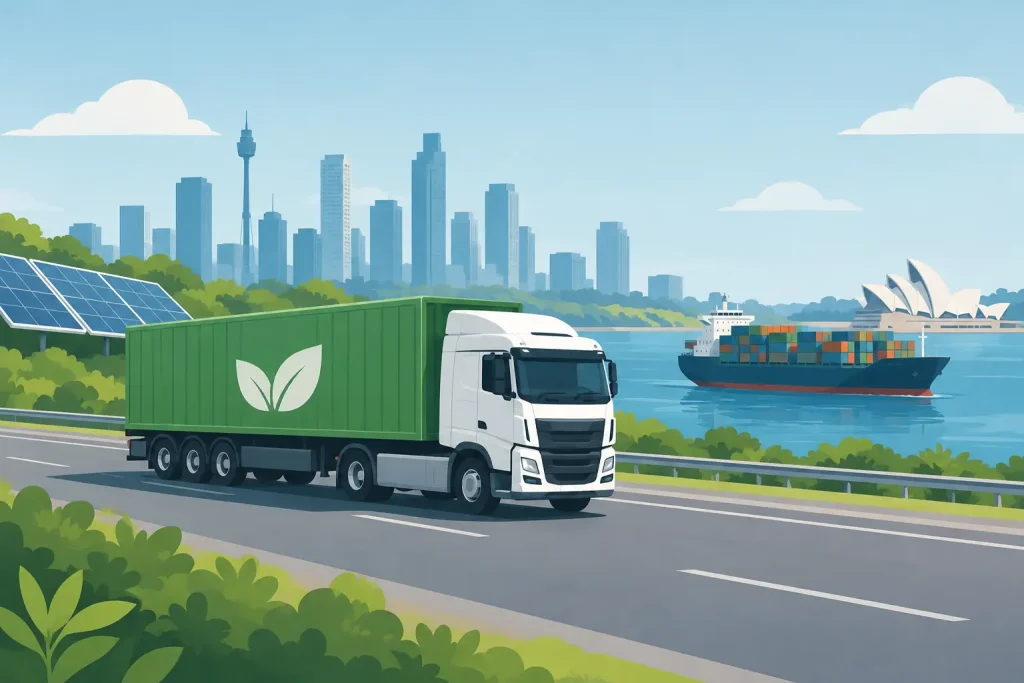
A shipment from Melbourne to Perth can travel more than 3,400 kilometres by road. Add an imported container, a regional delivery run or an urgent airfreight requirement, and the environmental and cost implications become significant quickly. Sustainable freight practices Australia businesses adopt need to work in real operating conditions: long distances, variable port schedules, customer delivery commitments and tightly managed margins.
For importers, exporters, retailers and manufacturers, sustainability is not achieved by selecting a single lower-emission transport option. It is built into freight planning, load design, carrier selection, warehousing and the quality of the data used to make decisions. Done properly, it can reduce fuel use, avoid wasteful movements and improve supply chain resilience at the same time.
Sustainable freight practices in Australia start with planning
The lowest-emission shipment is often the one that has not been rushed, rehandled or moved half-empty. That makes demand planning and freight booking discipline central to sustainable logistics.
Businesses should review how frequently they send goods, the order sizes being dispatched and whether freight is being booked late. Small, urgent consignments may seem manageable individually, but repeated airfreight, express road movements and split deliveries can materially increase both transport spend and emissions over a year.
Consolidating compatible orders into fewer shipments is usually the first practical opportunity. For sea freight, this may mean improving container utilisation, combining purchase orders or planning stock arrival dates further ahead. For domestic transport, it may mean setting sensible delivery windows that allow carriers to consolidate routes rather than dispatch a dedicated vehicle.
This is not a case for delaying every shipment. Critical machinery parts, seasonal retail stock and production inputs can have genuine time sensitivity. The objective is to separate genuinely urgent freight from freight made urgent by weak forecasting, late approvals or fragmented supplier coordination.
Choose the right mode for the freight task
Mode selection has one of the largest effects on freight emissions. Sea freight is generally the most efficient option for moving large volumes internationally, especially where lead times allow for containerised transport. Rail can also provide an effective lower-emission option across suitable domestic corridors, particularly for containerised freight and higher-volume interstate movements.
Road freight remains essential in Australia. It connects ports, rail terminals, warehouses, regional centres and final delivery points that cannot be served another way. The opportunity is to use road transport efficiently through route planning, load consolidation, suitable vehicle selection and reduced empty kilometres.
Air freight has a valuable place in supply chains, but it should be used with purpose. It is often appropriate for high-value, time-critical or temperature-sensitive cargo, or where a production shutdown would cost more than the premium transport option. Using it as a routine solution for late purchase orders is harder to justify commercially and environmentally.
A multimodal freight plan allows each leg to use the most appropriate method. For example, an importer may move a full container by sea, use rail for an interstate linehaul where available, then arrange road cartage for final delivery. The best outcome depends on cargo type, volume, delivery deadline, infrastructure access and handling requirements.
Improve container, pallet and vehicle utilisation
Transport capacity is a finite resource. Sending partially filled containers, poorly planned pallets or vehicles with unused space increases the emissions attributable to each unit of product.
For import and export sea freight, businesses can improve utilisation by reviewing carton dimensions, pallet configurations and container loading plans. A small packaging change can sometimes increase the number of saleable units in a container, reducing the total number of containers required across a season. This needs to be balanced against product protection, weight limits, manual handling requirements and customer presentation standards.
For road freight, accurate weights and dimensions help ensure the correct vehicle is allocated. Overspecifying vehicles wastes capacity, while inaccurate freight details can create rebooking, rehandling and compliance risks. Pallet exchange requirements, site access restrictions and delivery equipment should also be confirmed early so freight does not require an avoidable second movement.
Backloading can reduce empty running on suitable lanes. Businesses with regular interstate or regional freight should discuss whether collection and delivery schedules can align with established carrier networks. It may not always provide the fastest transit time, but it can be a strong option where delivery dates are flexible.
Use warehousing to reduce unnecessary transport
Warehouse location and inventory strategy affect freight performance well before goods reach the road. Holding stock in the right location can reduce long-distance replenishment, repeated transfer movements and last-minute express deliveries.
A well-managed 3PL arrangement can support more efficient order fulfilment by consolidating inventory, picking orders accurately and dispatching freight in planned waves. For businesses supplying multiple customers in one metropolitan area, coordinated deliveries from a local warehouse may be more efficient than sending individual shipments from an interstate distribution point.
There is a trade-off. Maintaining stock across several locations can shorten final delivery distances, but it can also create additional inventory holding, transfer freight and administration. The right network design depends on product turnover, customer service expectations, order profiles and the cost of being out of stock.
Packaging deserves attention here as well. Right-sized, durable packaging reduces wasted space and can lower damage rates. Fewer damages mean fewer replacement shipments, returns and disposal costs. Reusable packaging systems may suit closed-loop business-to-business supply chains, although they require reliable return logistics and cleaning processes to deliver a genuine benefit.
Make carrier performance part of procurement
Sustainable freight outcomes cannot be managed solely by the shipper. Freight forwarders, carriers, warehouse operators and subcontractors all influence the result.
When reviewing providers, businesses should look beyond a broad environmental statement. Ask how the operator manages fuel efficiency, fleet maintenance, route optimisation, driver training, load consolidation and emissions reporting. For international freight, it is also reasonable to ask how sea and air carrier options are assessed across transit time, reliability and emissions intensity.
Price remains important, particularly in a market where freight costs can shift rapidly. However, the lowest quoted rate may not account for additional handling, poor schedule reliability, demurrage exposure or the cost of missed customer delivery windows. Procurement decisions should consider total landed cost and operational risk alongside sustainability measures.
For complex import, export and domestic freight programs, an integrated provider can help identify where handovers are creating avoidable movements or delays. MCC World International coordinates freight, customs clearance, cartage, warehousing and distribution so businesses can assess the movement as one supply chain rather than a series of disconnected bookings.
Build sustainable freight practices Australia can measure
A sustainability plan without reliable freight data becomes difficult to improve or defend. Start with the information already available in freight invoices, transport management systems, warehouse records and supplier shipping documents: mode, origin, destination, weight, volume, distance, shipment frequency and carrier.
From there, establish a practical baseline. Track total freight movements and spend, then identify the lanes, customers, suppliers or product groups responsible for the highest activity. Emissions calculations should use a consistent methodology and clearly state any assumptions, particularly where actual carrier fuel data is unavailable.
Good reporting does not need to be overly complicated at the outset. A useful monthly or quarterly review can show whether airfreight use is increasing, whether container fill rates are improving, how many urgent consignments were sent and whether delivery consolidation is reducing transport activity. These indicators create accountability across procurement, sales, operations and logistics teams.
Businesses should also be careful with carbon offset claims. Offsets may form part of a broader climate approach, but they do not replace reducing avoidable fuel use and inefficient freight movements. Direct operational improvements are easier to measure and usually provide stronger commercial benefits.
Turn intent into operating discipline
The most effective sustainable freight program is usually built through a series of practical decisions: forecast earlier, consolidate where possible, select the right mode, use assets efficiently and review the data regularly. Assign ownership to the people who approve purchase orders, book transport, manage inventory and negotiate customer delivery terms.
Start with one high-volume lane or a recurring problem such as regular emergency airfreight. Set a realistic target, measure the result and apply the lessons across the wider network. Sustainable freight is not separate from supply chain performance. When planned carefully, it is a more controlled, cost-aware way to move cargo across Australia and international markets.