
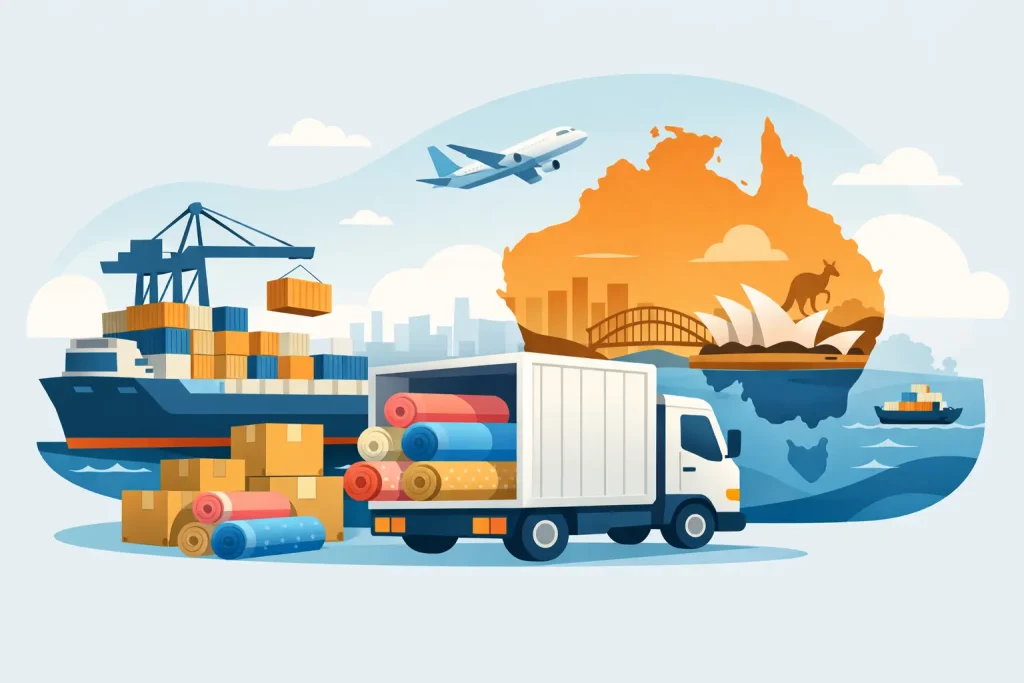
A delayed textile shipment rarely stays a freight problem for long. It quickly becomes a stock problem, a production problem, or a customer delivery problem. That is why textile shipping businesses in Australia need more than port-to-port movement. It needs careful planning around product type, packing, customs, timing and local delivery.
Textiles move through supply chains with very little tolerance for error. Retailers work to seasonal buying windows. Manufacturers depend on fabric inputs arriving in sequence. Wholesalers need predictable replenishment across multiple SKUs and warehouse locations. If freight is booked without enough attention to cargo detail, the result is often avoidable cost, delays at clearance, or damage in transit.
For Australian importers and exporters, the most effective approach is to treat textile freight as part of a broader logistics strategy rather than a standalone shipment. Mode selection, document accuracy, packaging standards and final-mile coordination all matter because textiles are commercially sensitive cargo, even when they are not classed as complex freight.
What makes textile shipping in Australia different
Textiles cover a wide range of products, and each one behaves differently in transit. Rolled fabric, boxed garments, soft furnishings, industrial textiles and homewares may all sit under the same commercial category, but they present different handling and storage requirements.
Garments and finished textile goods are often high-volume, carton-based shipments where timing is tied to sales cycles. Raw fabrics can be heavier, denser and more vulnerable to moisture, crushing or contamination. Upholstery, rugs and soft furnishings may take up significant cubic space, which changes the freight economics. In many cases, the shipment is not fragile in the traditional sense, but it is still vulnerable to warehouse compression, poor container loading and exposure to damp conditions.
This is where freight planning becomes practical rather than theoretical. Choosing sea freight because it appears cheaper per unit can make sense for stable stock lines, but not if missed delivery dates create markdown pressure or production downtime. Air freight can protect time-sensitive inventory, but only when the cargo value and urgency justify the higher rate. There is no single right model. It depends on the product, margin, lead time and sales forecast.
Choosing the right freight mode for textiles
Sea freight remains the most common option for larger textile volumes moving into Australia. It suits importers bringing in regular container loads of apparel, fabrics, linen, furnishings or mixed retail stock. Full container load movements provide stronger control over handling and packing, especially where product consistency matters. Less than container load can work well for smaller orders, but consolidation introduces more touchpoints, and that can affect both timing and cargo condition.
Air freight is often used when stock is urgent, seasonal or tied to a launch window. It is also a practical option when a shipment is smaller but commercially important. If a retailer is short on key lines ahead of a campaign, or a manufacturer needs fabric to keep production moving, the premium paid for air freight may be the cheaper outcome overall.
Road freight then becomes critical once cargo lands in Australia. Port or airport arrival is only one milestone. Textile consignments still need dependable cartage, warehouse intake, pallet control and delivery coordination across Melbourne, Sydney, Brisbane, Perth, Adelaide and regional areas. Delays often happen in this local leg, particularly when freight is technically available but not yet booked for the next movement.
Packaging and container planning matter more than many importers expect
Textiles are often seen as easy freight because they are not machinery, chemicals or oversized cargo. In practice, poor packing creates a steady stream of avoidable issues.
Moisture is one of the biggest risks during ocean transit. Fabrics and garments can absorb odour, humidity and contamination if container conditions are not managed properly. Cartons that are under-strength or poorly stacked can collapse during loading or while in transit. Rolled material can deform if it is not braced correctly. Mixed loads can also create problems if textiles are packed alongside cargo that sheds dust, leaks residue or carries strong smells.
Good textile freight planning starts with carton quality, pallet stability and container loading design. It also helps to think beyond the international leg. If cargo will be unpacked, stored, picked and distributed after arrival, packaging needs to support those downstream handling requirements as well. A shipment packed purely for export may still fail operationally if it is inefficient to receive and distribute in Australia.
Customs, classification and compliance
Customs compliance is one of the areas where textile shipping can become more technical than expected. Textile products can involve multiple tariff classifications depending on material composition, intended use and product construction. A cotton fabric roll, a synthetic garment and a textile floor covering may each sit under different classifications with different import considerations.
Errors here can slow clearance, affect duty assessment and trigger additional questions at the border. Commercial invoices, packing declarations, country of origin information and product descriptions need to match the actual goods. Generic descriptions such as fabric items or clothing stock are often not enough. The more precise the paperwork, the smoother the clearance process tends to be.
For businesses importing textiles regularly, consistency matters just as much as accuracy. Repeated shipments should follow the same document logic, product descriptions and booking process wherever possible. That reduces rework, improves predictability and gives operations teams a cleaner freight workflow.
Cost control in textile shipping in Australia
Freight cost is rarely just the base shipping rate. For textiles, costs build across mode choice, container utilisation, customs processing, local cartage, storage, handling and timing.
Volume plays a major role because many textile goods cube out before they weigh out. A consignment of pillows, garments or soft furnishings may consume significant space relative to its mass, which affects freight pricing. On the other hand, dense rolled fabrics or certain commercial textiles can create different cost pressure through weight and handling. If shipment planning is rushed, importers often pay for unused space, inefficient consolidation or split deliveries that could have been avoided.
There is also the cost of delay. Storage at port, container detention, re-delivery fees and warehouse disruption can quickly outweigh a small saving made at booking stage. Businesses usually get better long-term value from freight planning that protects supply chain continuity rather than chasing the cheapest quoted rate on a single movement.
Why integrated logistics improves textile outcomes
Textile freight tends to touch multiple operational stages in a short period of time. International shipping, customs clearance, unpack, warehousing, inventory management and local distribution all need to align. When those stages are managed separately, communication gaps appear. Cargo is available, but no one has booked collection. Customs is cleared, but delivery paperwork is incomplete. Stock reaches the warehouse, but inbound handling has not been scheduled.
An integrated logistics model reduces those breakpoints. That is especially useful for importers managing retail programmes, replenishment cycles or multiple suppliers across different origins. Instead of treating sea freight, air freight, road transport and storage as separate services, businesses can coordinate them as one operating plan.
This is where a provider with end-to-end capability adds value. MCC World International supports textile freight with customs, multimodal transport, warehousing and delivery coordination so cargo keeps moving after arrival, not just until arrival.
When textile shipments need a tailored plan
Not every textile movement is routine. Some shipments involve mixed product lines, urgent replenishment, seasonal pressure or supplier inconsistency. Others include commercial fit-out materials, flooring products, furnishings or project-based textile cargo that must arrive in sequence with installation schedules.
In these cases, standard booking processes can be too narrow. A tailored freight plan may involve splitting urgent stock from bulk stock, using air freight for one portion and sea freight for the balance, or holding cargo in local storage to support staged distribution. It may also mean coordinating container unpack and final delivery around warehouse labour availability or retail site access.
That level of planning does not need to make freight more complicated. Done properly, it removes unnecessary friction from the supply chain and gives procurement, operations and warehouse teams clearer control over what arrives, when it arrives and how it is handled.
Textile supply chains reward businesses that plan ahead but stay flexible. The right freight model is not always the fastest or the cheapest. It is the one that protects stock condition, supports compliance, matches commercial timing and keeps local distribution on track. If your textile freight is starting to affect inventory flow, customer delivery or warehouse efficiency, that is usually the point where better logistics planning begins to pay for itself.