
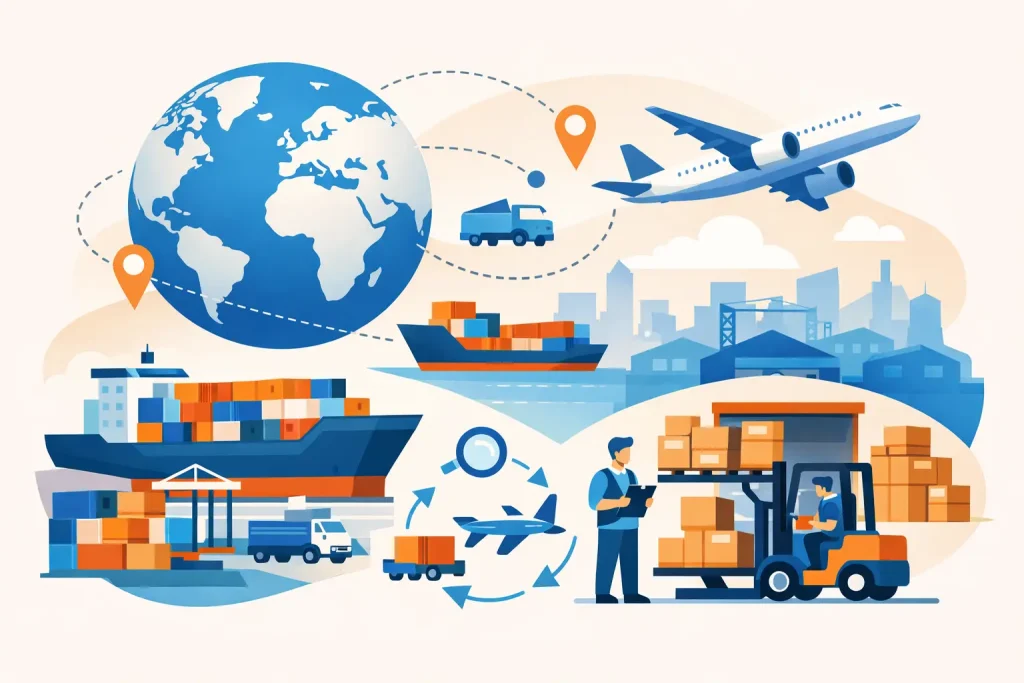
A shipment can leave a factory on time, clear the port late, miss a connecting vessel, arrive with incomplete paperwork, and still end up being labelled a “freight issue”. For most Australian businesses, that is the wrong diagnosis. What is international logistics and supply chain management? It is the full process of planning, moving, storing and controlling goods across borders so products arrive where they need to be, when they need to be there, with cost, compliance and continuity managed at every stage.
For importers, exporters, retailers, manufacturers and project cargo clients, this matters because freight is only one part of the commercial equation. The real objective is not simply getting cargo from one country to another. It is maintaining stock availability, protecting margin, meeting customer commitments and reducing operational risk.
What is international logistics and supply chain management in practice?
In practical terms, international logistics refers to the physical movement and handling of goods between countries. That includes transport by sea, air and road, along with documentation, customs clearance, cargo handling, storage and final delivery. Supply chain management is broader. It covers the coordination of suppliers, production schedules, inventory, warehousing, transport, distribution and information flow across the entire chain.
When these two functions work together, businesses gain more control over landed cost, lead times and service reliability. When they are treated separately, the result is often fragmented decision-making. A business may book the cheapest freight option, for example, only to absorb higher storage charges, stockouts or compliance delays later in the chain.
That is why experienced operators look beyond the shipment itself. They consider the origin point, the route, the mode, the handover points, the customs requirements, the warehouse plan and the delivery outcome as one connected operation.
The difference between logistics and supply chain management
The two terms are often used interchangeably, but they are not identical.
Logistics is primarily concerned with execution. It focuses on how cargo is packed, booked, transported, cleared, stored and delivered. If a container needs cartage from port to warehouse, if an airfreight consignment needs urgent uplift, or if oversized machinery requires specialist handling, that sits within logistics.
Supply chain management is the wider control framework around those activities. It deals with forecasting, procurement timing, supplier coordination, inventory strategy, warehouse flows, distribution planning and performance monitoring. In short, logistics moves the goods. Supply chain management aligns the movement with commercial demand.
For Australian businesses, this distinction has real value. A delayed shipment is not always caused by the transport provider. It may be linked to poor ordering cycles, unrealistic lead-time assumptions, weak supplier communication or inadequate buffer stock. A sound supply chain strategy addresses those upstream and downstream pressures before they become freight problems.
The core components of international logistics
International logistics is made up of several moving parts, and each one affects the final result.
Transport mode selection is one of the first decisions. Sea freight is generally more cost-effective for larger volumes and less time-sensitive cargo, while air freight supports urgent, high-value or lower-volume shipments. Road freight then becomes critical for local pick-up, port transfers and final mile delivery within Australia.
Customs clearance is another central component. Goods crossing borders must meet documentation, tariff, duty, tax and quarantine requirements. Errors here can lead to delays, inspections, penalties or unexpected costs. For businesses importing into Australia, compliance is not an administrative afterthought. It is a core operational requirement.
Warehousing and distribution also play a significant role. Cargo may need temporary storage, unpacking, palletising, inventory management or staged dispatch across multiple delivery points. This is especially relevant for retail freight, building materials, furniture, project cargo and seasonal stock movements.
Then there is visibility and coordination. International freight often involves multiple parties – supplier, shipper, carrier, customs broker, warehouse, transport operator and consignee. Without clear communication and planning, small gaps between those parties can create expensive delays.
Why supply chain management matters beyond transport
A business can have a competent freight provider and still run an inefficient supply chain. That usually happens when decisions are made in silos.
If procurement teams order too late, logistics has to rely on airfreight to recover time. If inventory settings are too lean, any port delay can trigger stock shortages. If product classification is inaccurate, customs clearance becomes slower and more expensive. Supply chain management brings these decisions into one commercial framework so transport choices support business performance rather than constantly reacting to problems.
This is particularly important in Australia, where international freight often includes long transit legs, strict import requirements and domestic distribution across wide geographic areas. Businesses need more than shipment execution. They need planning that reflects lead times, seasonal demand, landed cost and delivery expectations across the full chain.
Common challenges for Australian importers and exporters
International supply chains rarely fail because of one dramatic event. More often, they are affected by a series of manageable but poorly coordinated issues.
Transit time variability is a common example. Ocean schedules can shift, ports can congest, and connecting services can change. For some cargo, the lower cost of sea freight still makes commercial sense. For others, the risk to stock availability may justify a different mode or a revised ordering schedule.
Customs and biosecurity requirements are another pressure point. Australia maintains strict controls, and that is appropriate. But it means documentation accuracy, tariff classification and cargo declarations must be handled properly from the outset. Problems at origin often become clearance delays at destination.
Cost control is also more complex than comparing freight rates. The cheapest quoted shipment may not deliver the lowest landed cost once port charges, storage, detention, cartage, handling and timing impacts are considered. Good supply chain management weighs the total cost, not just the visible transport charge.
For oversized freight, machinery, vehicles or project cargo, the complexity increases again. Route planning, permits, specialised equipment and staged handling all need careful coordination. These jobs demand operational experience, not generic freight booking.
How businesses improve international logistics and supply chain performance
The first step is to treat freight as part of a broader operational system. Businesses that perform well usually have realistic lead-time planning, reliable supplier communication and clear accountability across shipping, customs and delivery stages.
They also choose transport modes based on business need rather than habit. Not every urgent shipment should move by air, and not every large shipment belongs on the slowest sea service available. The right decision depends on stock position, cargo value, customer deadlines and margin pressure.
Documentation discipline makes a substantial difference. Commercial invoices, packing lists, permits, tariff classifications and origin details should be accurate before cargo departs. Fixing errors after arrival is almost always slower and more expensive.
Visibility matters too, but only if it supports action. Tracking is useful when it helps a business plan warehouse labour, manage customer delivery windows or adjust inventory allocations. Data without response does not improve the supply chain.
Finally, integrated coordination reduces risk. When freight, customs, cartage, warehousing and distribution are handled within a connected operating model, handover issues are reduced and accountability is clearer. That is often where specialist logistics partners add the most value.
When a freight forwarder becomes a supply chain partner
Not every business needs the same level of support. A straightforward full-container import with stable ordering patterns may require efficient execution and competitive pricing. A multi-origin supply chain with varied cargo types, urgent replenishment cycles and domestic distribution needs much closer coordination.
The difference lies in whether your provider is simply moving bookings or actively managing outcomes. A capable logistics partner looks at routing options, customs risk, delivery sequencing, warehousing requirements and exception handling as part of the service. That approach is particularly useful for businesses dealing with high-volume imports, specialist cargo, or recurring shipments where small inefficiencies accumulate over time.
For many Australian operators, this is where a company such as MCC World International can make a practical difference – not by adding complexity, but by bringing sea freight, air freight, customs clearance, cartage, warehousing and distribution into one coordinated process.
What good international logistics and supply chain management looks like
Good performance is usually not dramatic. Cargo arrives within expected windows. Costs are predictable. Documentation is accurate. Customs issues are handled early. Warehousing supports inventory flow rather than becoming a bottleneck. Delivery commitments are met with fewer surprises.
That does not mean every shipment runs perfectly. International freight always involves variables outside any one party’s control. Weather events, port congestion, carrier schedule changes and regulatory checks can still affect timing. The goal is not perfection. It is control, response capability and a supply chain structure that can absorb disruption without damaging the business.
If your freight decisions are regularly being made under pressure, the issue may not be transport alone. It may be that the wider supply chain needs better planning, better coordination and a clearer view of total cost. That is usually where real improvement starts.